OUG = EMERGENCY ORDINANCE no. 195 of December 12, 2002 (Road Traffic Code)
Regulament = REGULATION for the implementation of OUG 195/2002 (Road Traffic Code Regulation)
(1) The driver of a vehicle who performs a maneuver of changing the direction of travel, of exiting from a row of waiting vehicles or of entering such a row, of moving to another lane of travel or of turning right or left or who is going to perform a U-turn or to move in reverse is obliged to signal in time and to make sure that he can do it without disturbing the traffic or endangering the safety of the other traffic participants.
(2) The signalling of the change of direction of travel must be maintained throughout the duration of the maneuver.
(4) In roundabout intersections, signalled as such, the vehicles that circulate inside them have priority over those that are going to enter the intersection.
For the purpose of this regulation, the terms and expressions below have the following meaning:
4^1. roundabout intersection - controlled intersection, signalled as such, provided with one or more lanes of travel, in which the traffic takes place in a single direction around a central area; (Point 4^1 was added to the law and posted also on Școala Rutieră on 17-02-2023)
(1) At the intersections provided with signs and/or with markings for signalling the direction of travel, the drivers of vehicles must move into position on the lanes corresponding to the desired direction of travel at least 50 m before the intersection and are obliged to respect the meaning of the signs and markings.
(1^1) In the case of roundabout intersections, the drivers of vehicles must respect the rules regarding lane travel, having the obligation to signal in time the exit from the intersection and to make sure that they can do it without disturbing the traffic or endangering the safety of the other traffic participants. (Paragraph (1^1) was added to the law and posted also on Școala Rutieră on 17-02-2023)
(2) At the intersections without lane delimitation markings, the drivers of vehicles occupy in travel, at least 50 m before the intersection, the following positions:
a) the row next to the curb or shoulder, those who want to change the direction of travel to the right;
b) the row next to the axis of the road or next to the marking for separation of directions, those who want to change the direction of travel to the left. When traffic takes place on one-way roads, the drivers of vehicles who intend to turn left are obliged to occupy the row next to the curb or the shoulder on the left side;
c) either of the rows, those who want to go straight ahead.
(1) The drivers of motor vehicles, agricultural or forestry tractors and trams are obliged to use the lighting and/or signalling installations with which the vehicle is equipped, as follows: (The introductory part of paragraph (1) of art. 114 was modified and updated on www.scoalarutiera.ro on 06-10-2021)
g) the direction indicators for signalling the change of direction of travel, including when putting the vehicle in motion from standstill.
(1) The drivers of vehicles are obliged to signal the change of direction of travel, overtaking, stopping and putting in motion.
(2) The intention of the drivers of motor vehicles, agricultural or forestry tractors and trams to change the direction of travel, to exit from a row of waiting vehicles or to enter such a row, to move to another lane of travel or to turn right or left or those who are going to perform a U-turn, overtaking or stopping is signalled by operating the direction indicators at least 50 m in the urban area and 100 m outside built-up area before the beginning of performing the maneuvers.
The driver of a vehicle is obliged to give priority also in the following situations:
d) when he is going to enter an intersection with traffic in a roundabout in relation to the one who circulates inside it;
If you cannot/do not want to watch the AUDIO-VIDEO version of the course, you can read the text version illustrated with images.
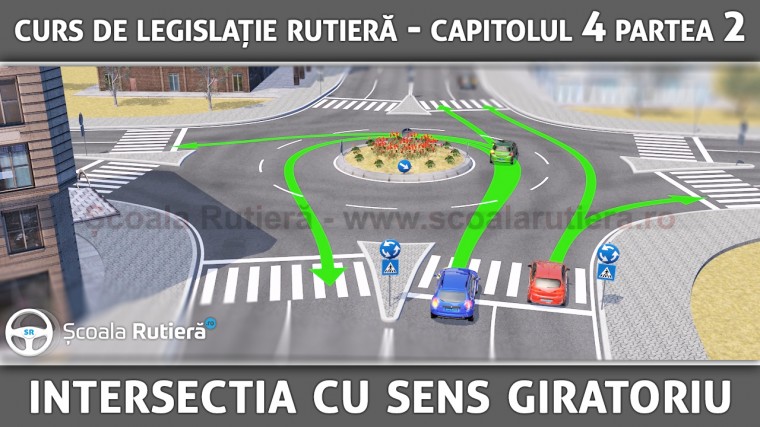
DEFINITION: the roundabout intersection is a controlled intersection, signalled as such, provided with one or more lanes of travel, in which the traffic takes place in a single direction around a central area (art. 2 point 4^1 of the Regulation). The central area may consist of a roundabout, a monument or a round marking of prohibited area. The signalling is done by installing on each road that enters the intersection the mandatory sign “Roundabout intersection”, installed right at the entrance to the intersection.
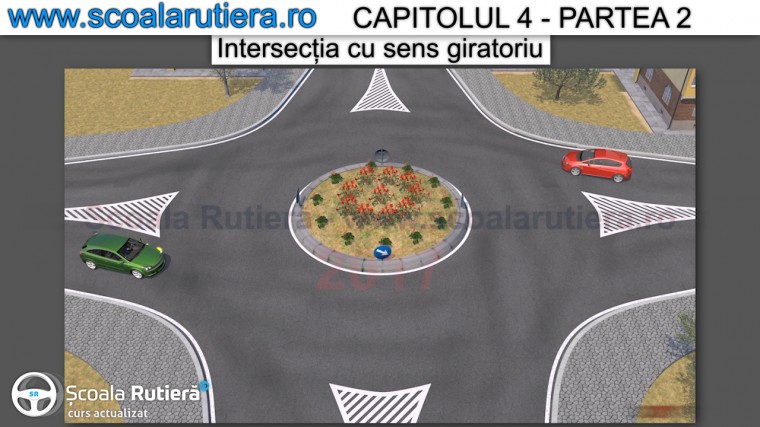

The roundabout intersections are controlled intersections, where due to the specific shape, the following additional obligations are respected:


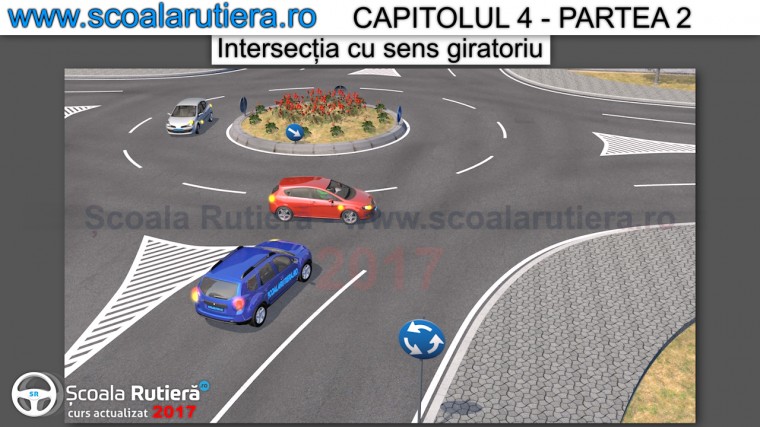

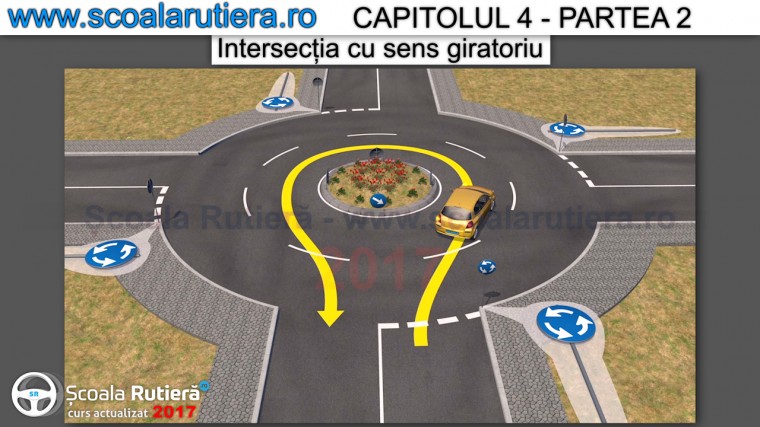

We take as an example the most common roundabout intersection, being the one with two lanes of travel and with four exits and entrances. The drivers of vehicles who want to enter a roundabout intersection, will move on the lanes of travel, depending on the desired direction of travel, as follows:


The road legislation does not establish special rules for signalling the change of direction of travel for roundabout intersections. When passing through these intersections you will signal respecting the same rules regarding signalling the change of direction of travel that you respect also in the other types of intersections, thus each change of direction of travel will be signalled accordingly, this helping the other traffic participants to know your intentions and implicitly will help the safety and the good conduct of the road traffic. (art. 54 of OUG, art. 114 paragraph (1) letter g) and art. 116 paragraphs (1), (2) of the Regulation)
It is recommended that the signalling of the change of direction of travel in the roundabout intersections be done as follows:


You must take into account that when changing the lane of travel inside the roundabout intersection you must respect the rules regarding travel on lanes and when leaving the intersection you have the obligation to signal in time this intention and to make sure that you can do it without disturbing the traffic or endangering the safety of the other traffic participants. (art. 107 paragraph 1^1 of the Regulation)















Leave a comment