OUG = GOVERNMENT EMERGENCY ORDINANCE no. 195 of December 12, 2002 (Road Traffic Code)
Regulation = REGULATION for the implementation of OUG 195/2002 (Road Traffic Code Regulation)
(6) The tram in motion may also be overtaken on the left side when the road is one-way or when between the right rail and the edge of the sidewalk there is not enough space.
(2) At the intersections without lane delimitation markings, the drivers of vehicles occupy while moving, at least 50 m before the intersection, the following positions:
b) the row next to the axis of the road or next to the marking separating the directions, those who want to change direction to the left. When the traffic takes place on one-way roads, the drivers of vehicles who intend to turn left are obliged to occupy the row next to the curb or the shoulder on the left side;
Is prohibited the U-turn of the vehicle:
d) on one-way roads;
(1) Is prohibited moving in reverse with the vehicle:
b) over a distance greater than 50 m;
(4) In the urban area, on one-way roads, stopping or voluntary waiting of vehicles is allowed also on the left side, if at least one traffic lane remains free.
If you cannot/do not want to watch the AUDIO-VIDEO version of the course, you can read the text version illustrated with images.

The one-way road is the public road where the traffic moves in a single direction.

The one-way road is recognized as follows:
1. it does not have the axis of the road (the axis of the road being the imaginary line or materialized by marking that separates the directions of traffic but the one-way direction having a single traffic direction the axis of the road no longer exists);

2. when approaching laterally a one-way road the information sign "One-way road" is encountered which also indicates the direction of the one-way road;
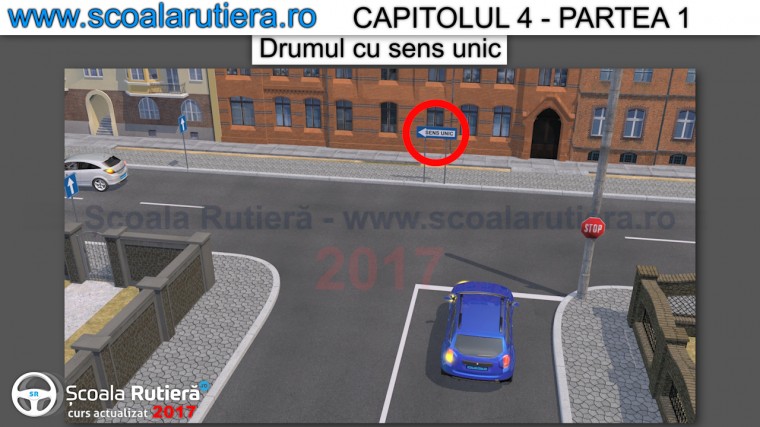
3. at the entrance to the one-way road the information sign "One-way road" is encountered which informs us that the road we are driving on is one-way;

4. at the exit from a one-way road the warning sign "Two-way traffic" is encountered which warns us that the traffic on that road is no longer carried out in one-way direction and it is a road with two-way traffic;
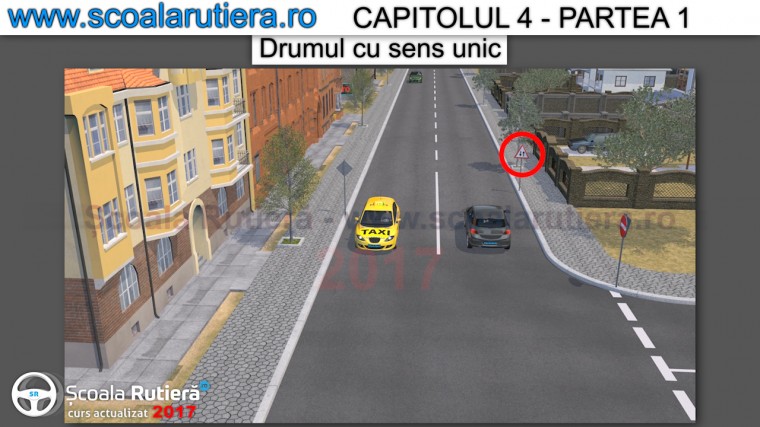
5. when approaching from the opposite direction a one-way road the prohibition sign "No entry" is encountered which prohibits access on that road in that direction.

In the urban area, on one-way roads, stopping or voluntary waiting of vehicles is allowed also on the left side, if at least one traffic lane remains free (art. 141 paragraph 4 of the Regulation).

At the intersections without lane delimitation markings on one-way roads, the drivers of vehicles who intend to turn left are obliged to occupy while moving, at least 50 m before the intersection, the row next to the curb or the shoulder on the left side (art. 107 paragraph 2 letter b of the Regulation).

Is prohibited the U-turn of the vehicle on one-way roads (art. 126 letter d of the Regulation).

Moving in reverse is allowed, but it can be performed over a maximum distance of 50 meters (art. 128 paragraph 1 letter b of the Regulation).

On roads with two-way traffic, trams in motion are overtaken on their right side. BUT on one-way roads, trams may also be overtaken on the left side (art. 45 paragraph 6 of the OUG).
















Leave a comment