OUG = GOVERNMENT EMERGENCY ORDINANCE no. 195 of December 12, 2002 (Road Traffic Code)
Regulation = REGULATION for the implementation of OUG 195/2002 (Road Traffic Code Regulation)
(1) The markings serve to organize traffic, warn or guide road users. They can be used alone or together with other road signalling means that they complete or specify the meaning.
(2) The longitudinal marking consisting of a single or double continuous line prohibits its crossing.
(3) The marking consisting of a continuous line applied to the curb of the sidewalk or at the edge of the carriageway prohibits the waiting of vehicles on that side of the road. When such a line accompanies a no-waiting sign, it specifies the length of the road section for which the prohibition applies.
(4) The longitudinal marking consisting of continuous lines that delimit the lane on which it is applied and a marking symbolizing a certain category or categories of vehicles signifies that the lane is reserved for the circulation of that or those categories of vehicles.
The longitudinal marking consisting of a single or double broken line allows crossing it if the maneuver or the regulations imposed require this.
(1) The broken line marking may be single or double and is used in the following situations:
a) single broken line marking:
1. for separating directions of travel on roads with two lanes and traffic in both directions;
2. for separating lanes in the same direction on roads with at least two lanes per direction;
3. for marking the transition from a broken line to a continuous line. In urban area this marking is not mandatory;
4. for separating, on motorways, acceleration or deceleration lanes from the current traffic lanes;
5. for guide markings in intersections;
b) double broken line marking, for delimiting reversible lanes. On such lanes the marking is accompanied by special light devices provided in art. 56.
(2) The continuous line is used in the following situations:
a) the single continuous line, for separating directions of travel, lanes in the same direction when approaching intersections and in dangerous areas;
b) the double continuous line, for separating directions of travel with at least two lanes in each direction, as well as on roads with one lane per direction or in other situations established by the administrator of the respective road, with the approval of the traffic police.
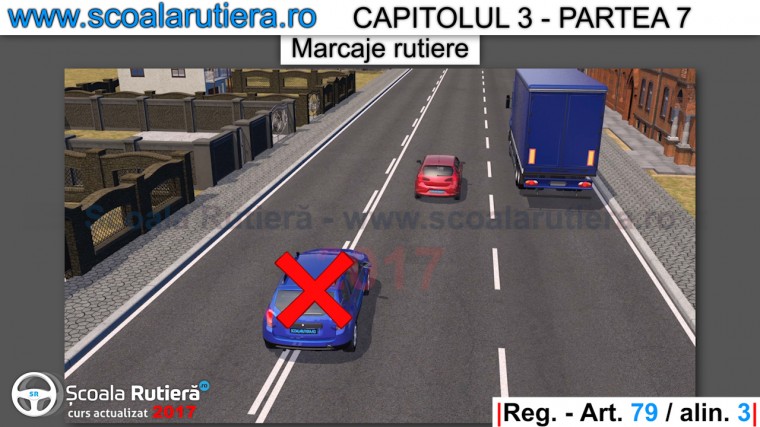
(3) In the case of the longitudinal marking consisting of a continuous and a broken line side by side, the driver of the vehicle must respect the meaning of the line closest in the direction of travel.
(1) The markings for delimiting the carriageway are placed along the road, applied at the right edge of the carriageway in the direction of travel, except for motorways and express roads where the marking is also applied on the left side, near the physical divider of the directions of travel. These markings may be continuous or single broken line.
(3) The markings for prohibiting waiting may be made:
a) by a yellow continuous line applied to the curb of the sidewalk or on the consolidation strip of the shoulder, doubling the marking for delimiting the carriageway towards the outside of the road platform;
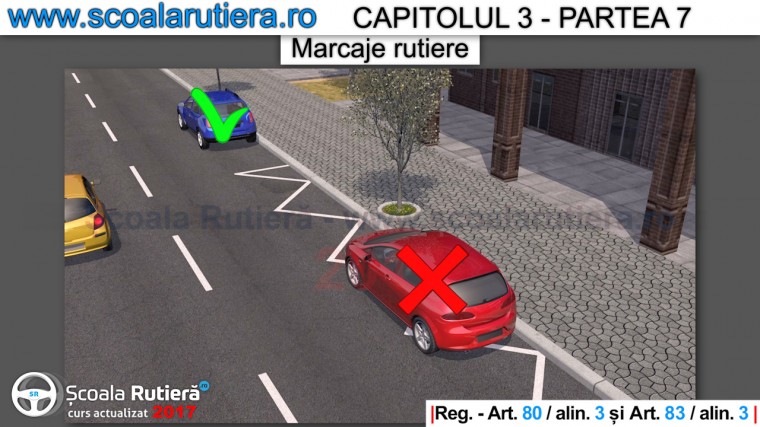
b) by a zig-zag line at the edge of the carriageway.
(4) The arrow markings are used for:
a) lane selection;
b) lane change (acceleration lane, additional lane for slow vehicles, the lane that terminates by narrowing the carriageway);
c) rejoining, only outside built-up area on roads with one lane per direction and two-way traffic.
(1) The transversal marking consisting of a continuous line, applied on the width of one or more lanes, indicates the line before which the vehicle must be stopped when encountering the "Stop" sign. Such a marking may be used to indicate the stop line imposed by a light signal, by an order of the traffic police officer directing traffic, by the presence of a level crossing with a railway, with a tram line or a pedestrian crossing. Before the marking accompanying the "Stop" sign, the inscription "Stop" may be applied on the carriageway.
(2) The transversal marking consisting of a broken line, applied on the width of one or more lanes, indicates the line that must not be crossed when giving way is required. Before such a line, a marking in the shape of a triangle with one side parallel to the broken line and the tip pointing towards the approaching vehicle may be applied.
(3) The transversal marking consisting of lines parallel to the axis of the road indicates the place where pedestrians must cross the road. These lines have a greater width than any other markings.
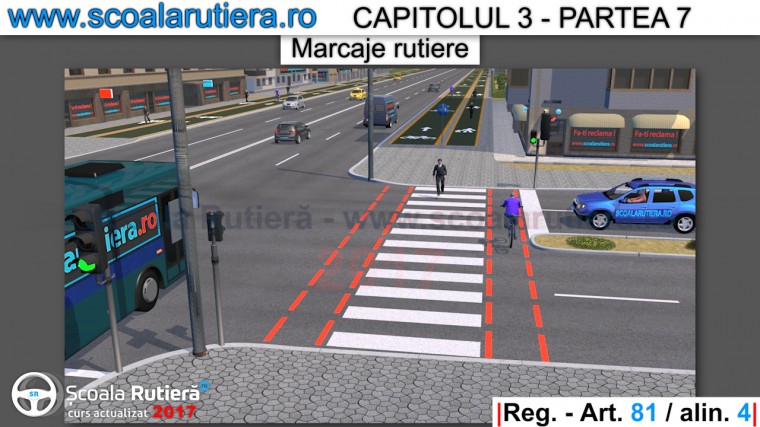
(4) The transversal marking consisting of parallel broken lines, applied perpendicular or oblique to the axis of the road, indicates the place intended for crossing the carriageway by bicycle riders or electric scooter riders. (Paragraph (4) of Article 81 was modified and updated on www.scoalarutiera.ro on 06-10-2021)
(2) On motorways, on express roads and on national roads open to international traffic (E), resonator markings are applied at the edges of the carriageway to warn the drivers of motor vehicles when leaving the carriageway.
(2) The marking in the shape of one or more arrows, applied on the lane or lanes delimited by continuous lines, obliges following the direction or directions thus indicated. The rejoining arrow, which is oblique to the axis of the road, applied on a lane or inserted in a longitudinal marking consisting of broken lines, signals the obligation that the vehicle not being on the lane indicated by the arrow must be driven on that lane.
(3) The marking consisting of a zig-zag line signifies the prohibition of waiting of vehicles on the road side on which it is applied. Such a line completed with the inscription «Bus», «Taxi» or «Tram» may be used to signal bus, trolleybus, taxi stations, respectively tram stations that do not have a refuge for pedestrians. (Paragraph (3) was modified and updated also on Școala Rutieră on 17-02-2023)
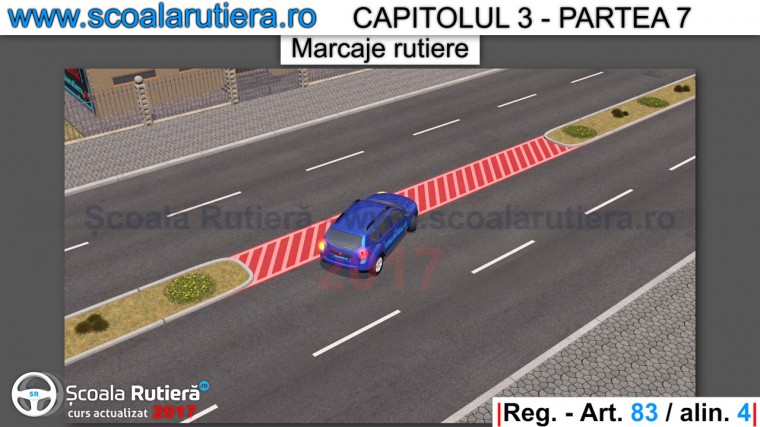
(4) The marking applied outside the lanes, consisting of parallel lines, surrounded or not by a contour line, delimits the space prohibited to traffic.
If you cannot/do not want to watch the AUDIO-VIDEO version of the course, you can read the text version illustrated with images.

The markings serve to organize traffic, warn or guide road users. They can be used alone or together with other road signalling means that they complete or specify the meaning (art. 75 paragraph 1 of the Regulation).
The longitudinal marking consisting of a single or double continuous line prohibits its crossing (art. 77 paragraph 2 of the Regulation).

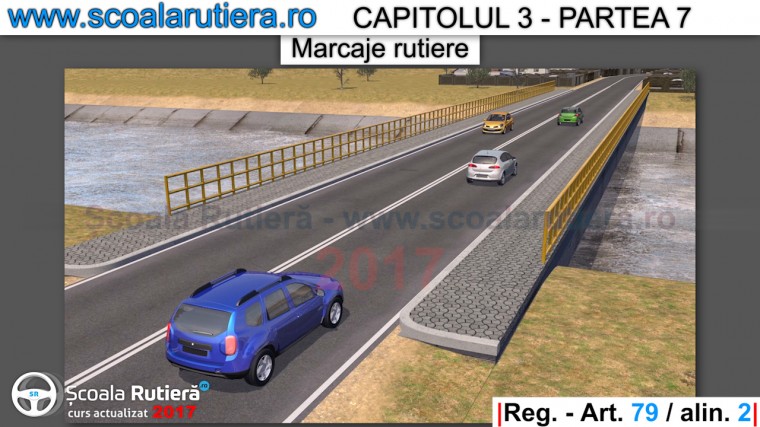
The continuous line marking is used in the following situations (art. 79 paragraph 2 of the Regulation):
a. the single continuous line:
b. the double continuous line:
The longitudinal marking consisting of a single or double broken line allows crossing it if the maneuver or the regulations imposed require this (art. 78 of the Regulation).
The broken line marking is used in the following situations (art. 79 paragraph 1 of the Regulation):
a. the single broken line:

b. the double broken line:

In the case of the longitudinal marking consisting of a continuous and a broken line side by side, the driver of the vehicle must respect the meaning of the line closest in the direction of travel (art. 79 paragraph 3 of the Regulation). For example in this situation the line closest in the direction of travel is the broken one, therefore the longitudinal marking may be crossed. Another example is this one where the line closest in the direction of travel is the continuous one and crossing the longitudinal marking is prohibited.

The markings for delimiting the carriageway are placed along the road, applied at the right edge of the carriageway in the direction of travel, except for motorways and express roads where the marking is also applied on the left side, near the physical divider of the directions of travel. These markings may be continuous or single broken line (art. 80 paragraph 1 of the Regulation).
The markings for prohibiting waiting may be made (art. 80 paragraph 3 of the Regulation and art. 77 paragraph 3 of the Regulation):
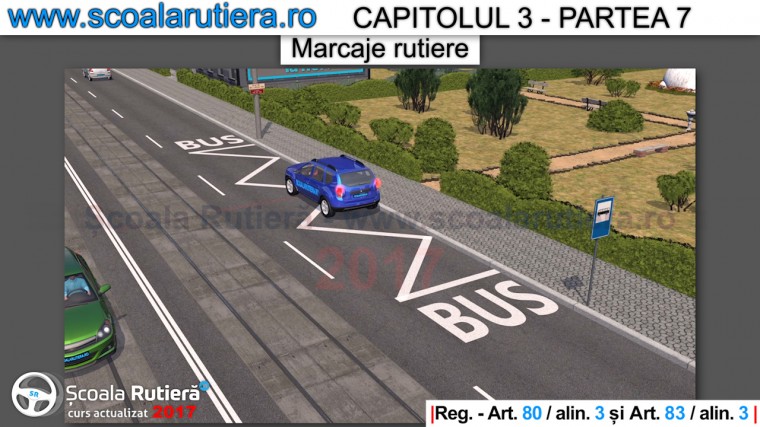
The longitudinal marking consisting of continuous lines that delimit the lane on which it is applied and a marking symbolizing a certain category or categories of vehicles signifies that the lane is reserved for the circulation of that or those categories of vehicles (art. 77 paragraph 4 of the Regulation).

The transversal marking consisting of a continuous line, applied on the width of one or more lanes, indicates the line before which the vehicle must be stopped when encountering the "Stop" sign. Such a marking may be used to indicate the stop line imposed by a light signal, by an order of the traffic police officer directing traffic, by the presence of a level crossing with a railway, with a tram line or a pedestrian crossing. Before the marking accompanying the "Stop" sign, the inscription "Stop" may be applied on the carriageway (art. 81 paragraph 1 of the Regulation).
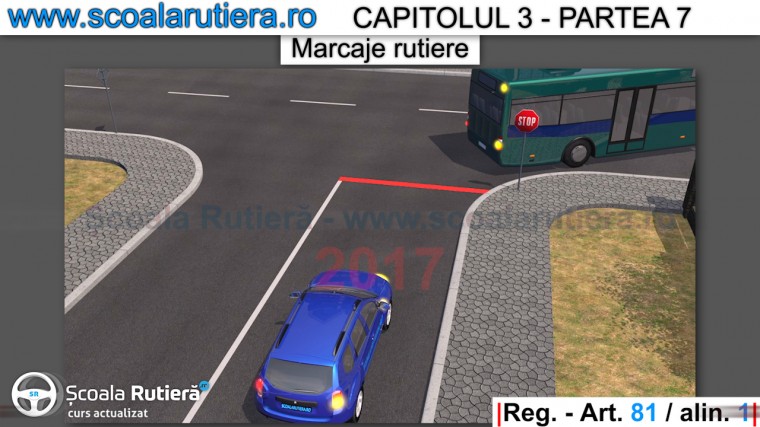
The transversal marking consisting of a broken line, applied on the width of one or more lanes, indicates the line that must not be crossed when giving way is required. Before such a line a marking in the shape of a triangle with one side parallel to the broken line and the tip pointing towards the approaching vehicle may be applied (art. 81 paragraph 2 of the Regulation).

The arrow markings are used for (art. 80 paragraph 4 of the Regulation and art. 83 paragraph 2 of the Regulation):
The transversal marking consisting of lines parallel to the axis of the road indicates the place where pedestrians must cross the road. These lines have a greater width than any other markings (art. 81 paragraph 3 of the Regulation).

The transversal marking consisting of parallel broken lines, applied perpendicular or oblique to the axis of the road, indicates the place intended for crossing the carriageway by bicycle riders or electric scooter riders (art. 81 paragraph 4 of the Regulation).
The marking applied outside the lanes, consisting of parallel lines, surrounded or not by a contour line, delimits the space prohibited to traffic (art. 83 paragraph 4 of the Regulation).

On motorways, on express roads and on national roads open to international traffic (E), resonator markings are applied at the edges of the carriageway to warn the drivers of motor vehicles when leaving the carriageway (art. 82 paragraph 2 of the Regulation).















Leave a comment