OUG = GOVERNMENT EMERGENCY ORDINANCE no. 195 of December 12, 2002 (Road Traffic Code)
Regulation = REGULATION for the implementation of OUG 195/2002 (Road Traffic Code Regulation)
The signs installed on public roads are:
a) warning signs;
b) regulatory signs, which may be:
1. priority signs;
2. prohibitory or restriction signs;
3. mandatory signs;
c) direction and information signs, which may be:
1. direction signs;
2. information signs;
3. tourist information signs;
4. additional panels;
5. kilometre and hectometre signs;
d) work signalling means, which include:
1. temporary road signs;
2. auxiliary means of signalling works.
(1) The signs are installed, as a rule, on the right side of the direction of travel. When local conditions prevent the timely observation of the signs by the drivers they are addressed to, they may be installed or repeated on the left side, in the median area of the road, on a refuge or space prohibited to vehicles, above the carriageway or on the opposite side of the intersection, in a visible place for all road users.
(2) The signs may be accompanied by panels with additional signs containing inscriptions or symbols that specify, complete, or limit their meaning.
(3) Additional signs may be applied on panels that include signs or even on the signs themselves, if the understanding of their meaning is not affected.
(1) The meaning of a sign is valid over the entire width of the carriageway open to the traffic of the drivers they are addressed to.
(2) When the sign is installed above the lane or lanes, its meaning is valid only for the lane or lanes thus signalled.
(3) The meaning of the warning sign begins from the place where it is installed. In the case of signs that warn of dangerous sections, the action area of the signs is regulated by additional panels.
(4) Warning signs are installed before the dangerous place, at a distance of maximum 50 m in the urban area, between 100 m and 250 m outside built-up area, respectively between 500 m and 1,000 m on motorways and express roads. When field conditions require installation at a greater distance, an additional panel "Distance between the sign and the beginning of the dangerous place" is installed under the sign.
(5) On motorways and express roads, in all cases, an additional panel "Distance between the sign and the beginning of the dangerous place" must be installed under the sign. If the length of the dangerous section exceeds 1,000 m, the additional panel "Length of the dangerous section to which the sign refers" is mounted under the sign.
(6) The meaning of prohibitory or restriction signs begins at the sign. In the absence of signalling that specifies the length of the sector to which the regulation applies or of signs announcing the end of the prohibition or restriction, the meaning of these signs ends at the nearest intersection. When prohibitory or restriction signs are installed together with the sign announcing the entry into a locality, their meaning is valid on the respective road until encountering the sign "Exit from the locality", except in places where other signs provide otherwise.
If you cannot/do not want to watch the AUDIO-VIDEO version of the course, you can read the text version illustrated with images.
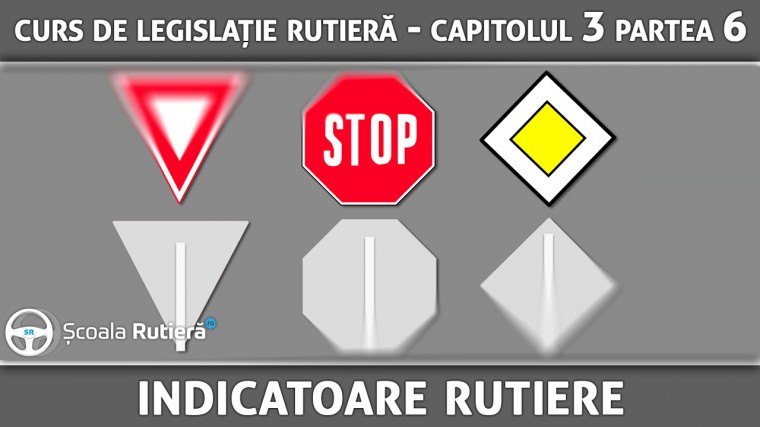
Road signs have the role of warning, regulating, guiding, and informing road users in order to ensure the full safety of traffic.
The signs installed on public roads are (art. 64 of the Regulation):
a) warning signs;
b) regulatory signs, which may be:
c) direction and information signs, which may be:
d) work signalling means, which include:
Warning signs generally have the shape of an equilateral triangle, with a red border in which, on a white background, various black symbols representing the nature of the dangers to be encountered are shown. Warning signs aim to alert road users about the existence of a danger on the road, also indicating its nature.
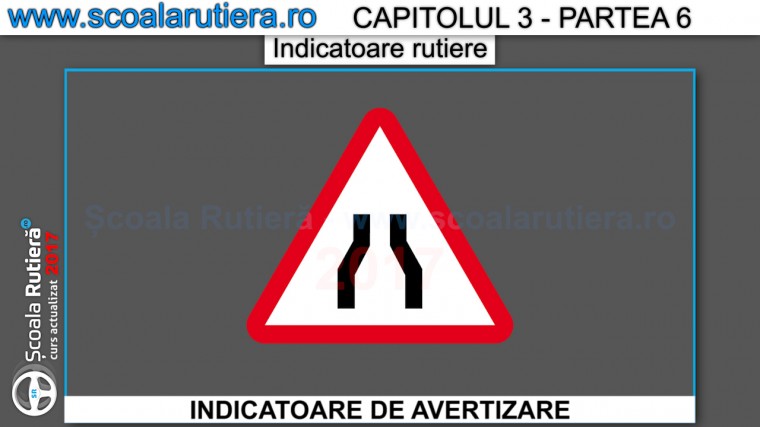
Under warning signs, the additional panels "Distance between the sign and the beginning of the dangerous place" and "Length of the dangerous sector to which the sign refers" may be installed (art. 66 paragraphs 3, 4, and 5 of the Regulation).
Regulatory priority signs regulate the order of entering an intersection when the travel trajectories of at least two vehicles intersect, or the order of passing on narrowed road sections that do not allow the simultaneous passage of two vehicles coming from opposite directions.
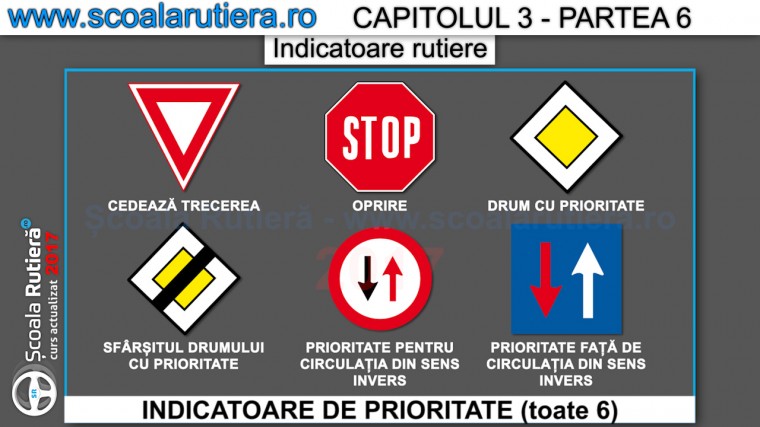
The signs by which traffic is regulated in an intersection are: "Give way", "Stop" and "Priority road". These have different shapes from the other signs, so that they can be identified even when seen from behind.
Prohibitory or restriction signs generally have a round shape, with a red border in which, on a white background, various black symbols are shown.
The meaning of prohibitory or restriction signs begins at the sign. In the absence of signalling specifying the length of the sector to which the regulation applies or of signs announcing the end of the prohibition or restriction, the meaning of these signs ends at the nearest intersection.
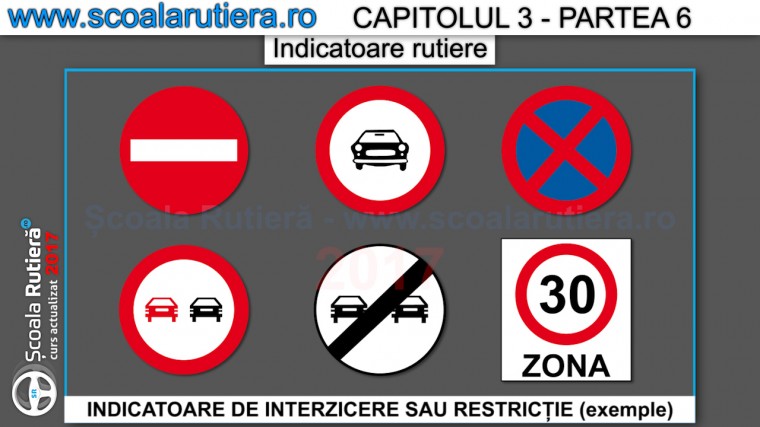
When prohibitory or restriction signs are installed together with the sign announcing entry into a locality, their meaning is valid on the respective road until encountering the sign "Exit from the locality", except in places where other signs provide otherwise (art. 66 paragraph 6 of the Regulation).
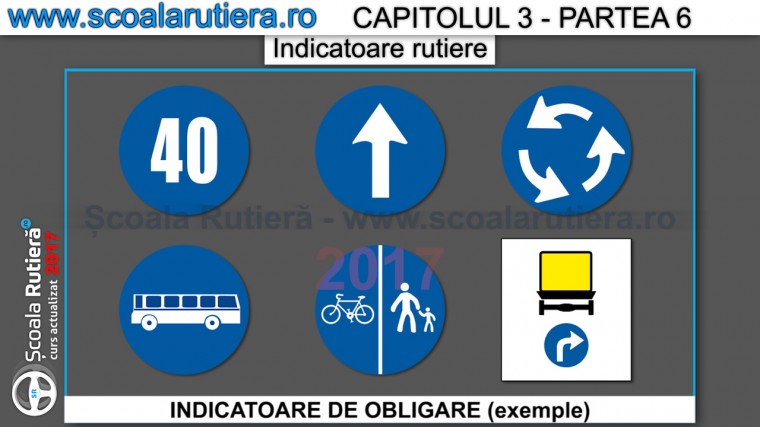
These generally have a round shape on a blue background with white symbols, obliging vehicle drivers to travel only in certain directions or to drive only on certain roads.
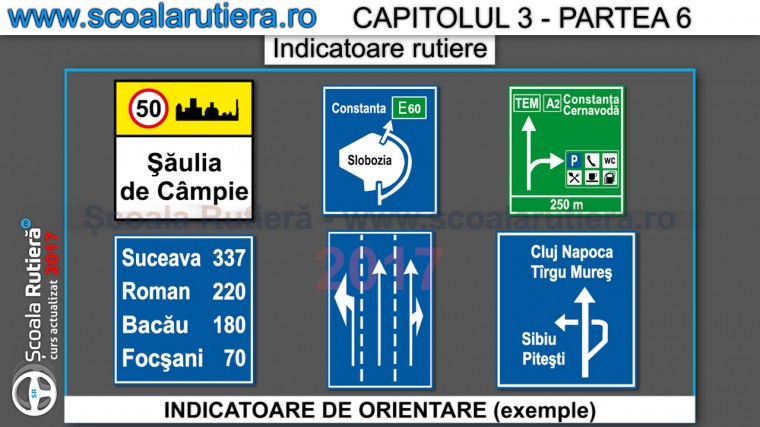
These signs generally have a rectangular or square shape on a blue or green background written with white characters, guiding vehicle drivers by pre-signalling the directions to follow, detour routes, destinations, or points of interest.
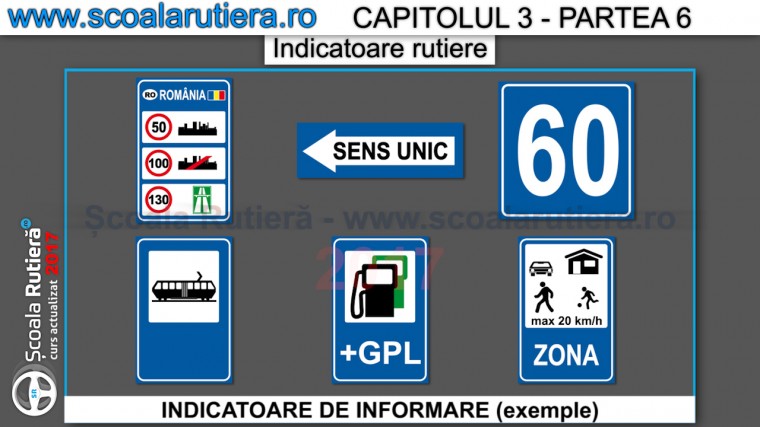
These signs inform vehicle drivers about the way of performing certain maneuvers, as well as about the existence of points of interest.
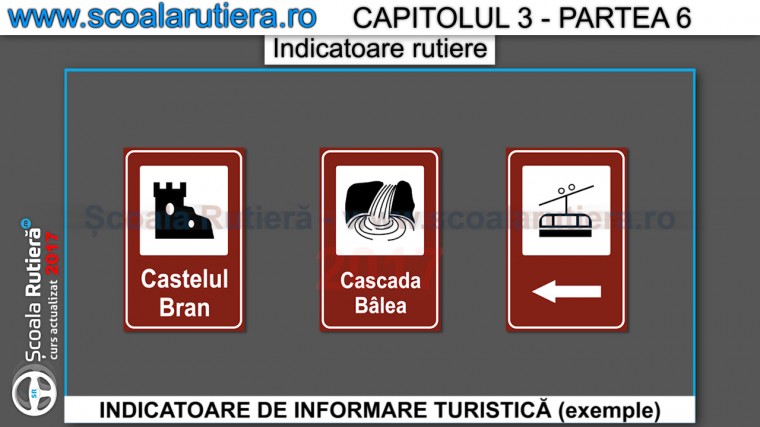
These signs inform vehicle drivers about the existence of tourist points.
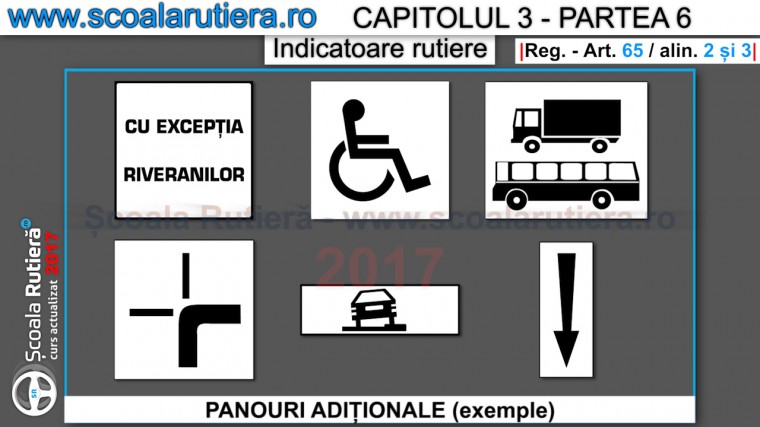
Additional panels may accompany signs and contain inscriptions or symbols that may specify, complete, or limit the meaning of the signs. Such inscriptions or symbols may also be applied on panels that include the signs or even on the signs themselves, if the understanding of their meaning is not affected (art. 65 paragraphs 2 and 3 of the Regulation).
Kilometre and hectometre signs are intended to inform road users about the distances between localities. They are installed on the margins of all categories of roads.
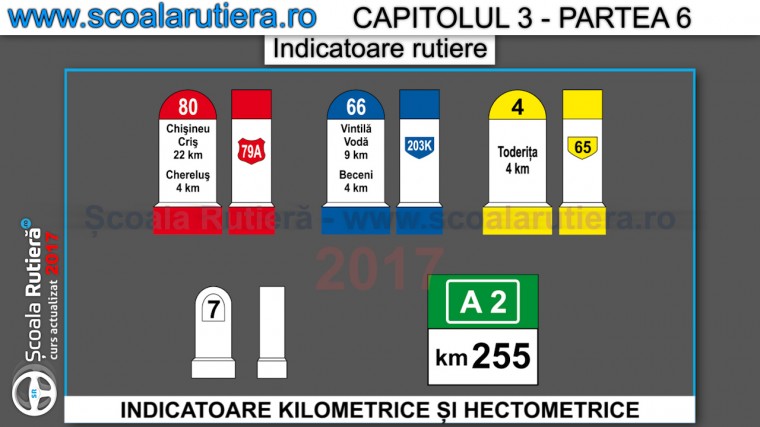
Kilometre signs are used to indicate the administrative category of the road, its order number in the network of public roads, as well as the kilometre position expressed as the distance in kilometres from the beginning of the road.
Kilometre signs also serve to indicate the distances to the centre of the first more important locality, as well as to the centre of the nearest locality.
Hectometre signs are installed between two kilometre signs every one hundred metres.
These modify the normal traffic conditions, their background being yellow.
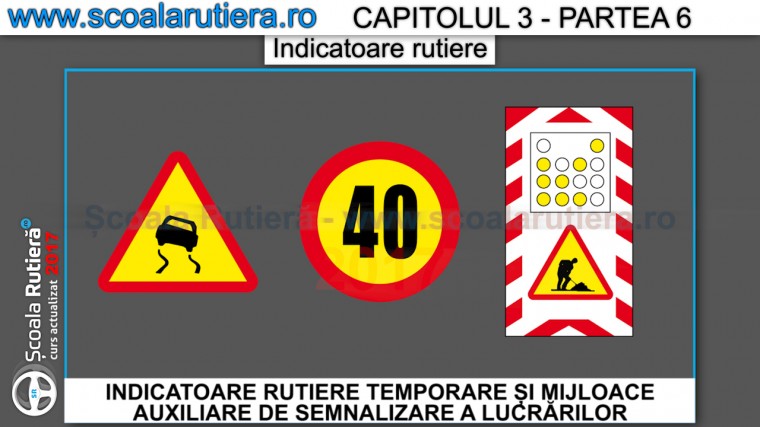
They are used on road segments open to traffic where:
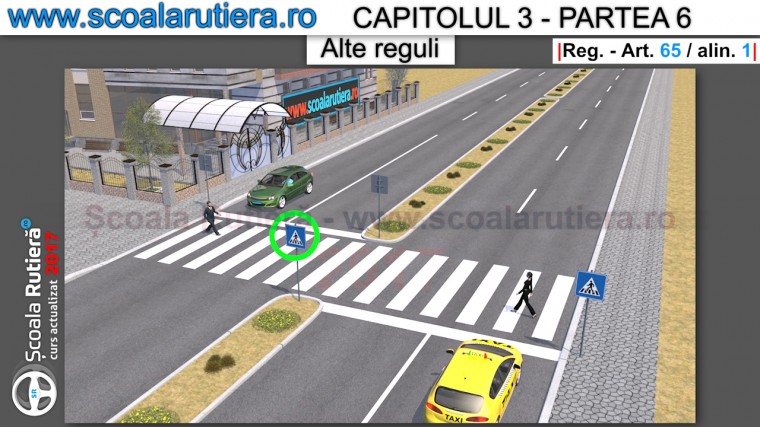
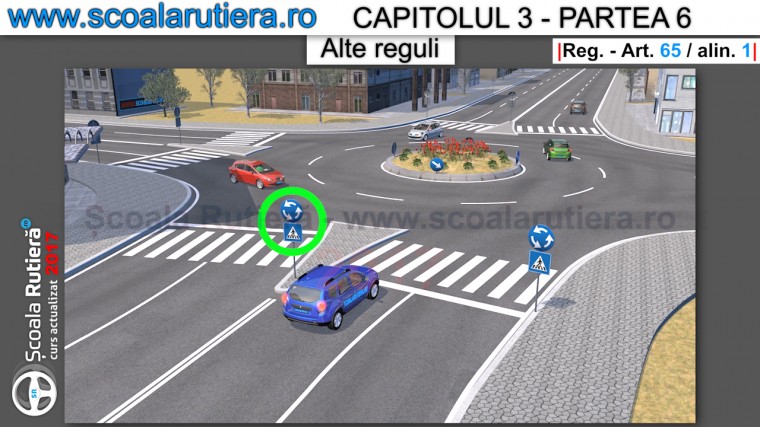
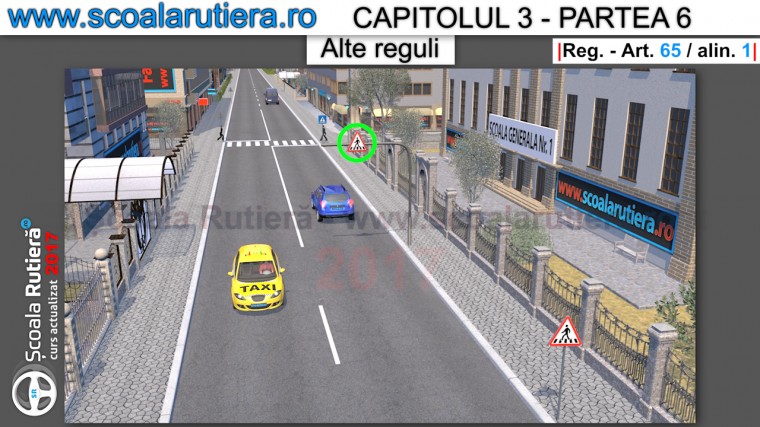
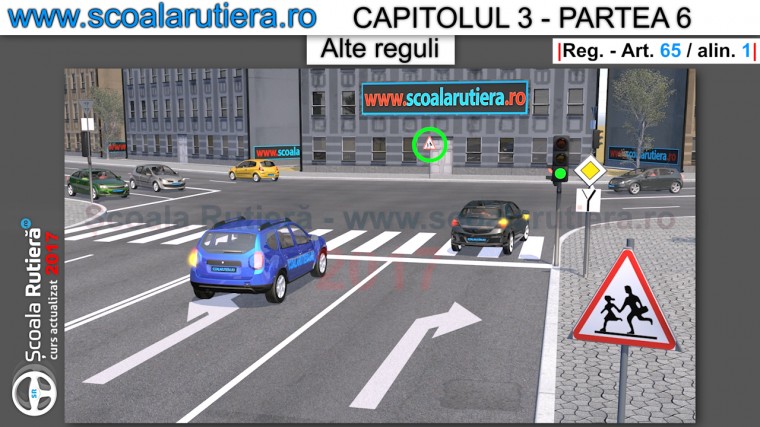
The signs are installed, as a rule, on the right side of the direction of travel. When local conditions prevent the timely observation of the signs by the drivers they are addressed to, they may be installed or repeated on the left side, in the median area of the road, on a refuge or space prohibited to the traffic of vehicles, above the carriageway or on the opposite side of the intersection, in visible places for all road users (art. 65 paragraph 1 of the Regulation).
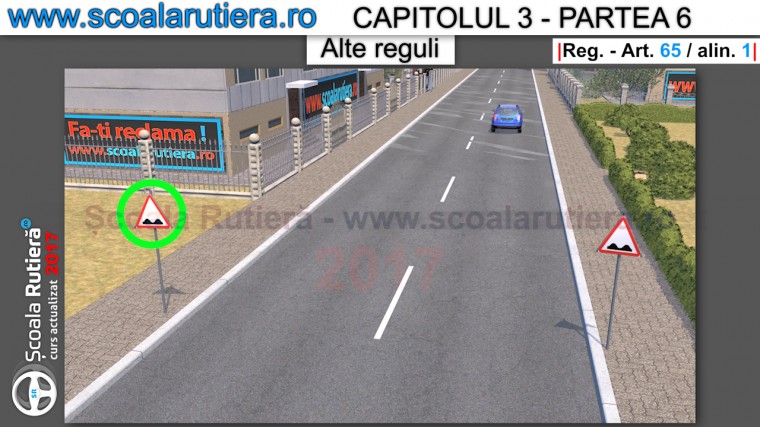
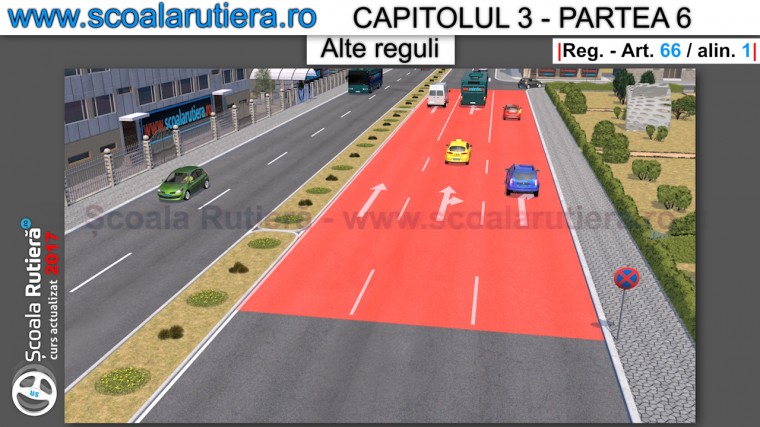
The meaning of a sign is valid over the entire width of the carriageway open to the traffic of the drivers they are addressed to (art. 66 paragraph 1 of the Regulation).
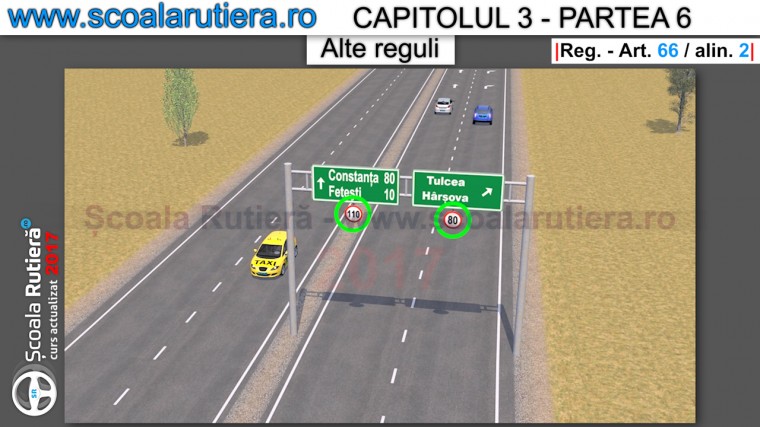
When the sign is installed above the lane or lanes, its meaning is valid only for the lane or lanes thus signalled (art. 66 paragraph 2 of the Regulation).














Leave a comment