Many people believe that we should never use the brake when the car is skidding, if it is on ice or if half of the car (two wheels) is on a surface with high grip and the other half on a surface with low grip, such as mud or dust. But in fact this is not always true.
Let us give an example. You move on a slippery road and the cars in front brake and stop, and you are too close to the car in front of you and you brake hitting hard the brake pedal, this will cause the wheels of the car to lock worsening the situation, more exactly, breaking the grip with the carriageway the car will move only straight ahead not allowing you to steer anymore to avoid the collision. From here comes the idea that we should not brake in situations where the carriageway is slippery or to use the engine brake instead of the service brake (the foot brake). In this situation it is recommended to be calm and precise with the pedal, adding a light and progressive pressure, this will reduce the travel speed and will not lock the wheels, offering you better control over the direction of the motor vehicle.
To help in situations like the one above, manufacturers have developed a safety system called ABS (Anti‑lock Braking System). This is a device for avoiding uncontrolled skidding by reducing harsh braking, more exactly it helps us in situations in which we panic and press hard or even hit the brake pedal, a situation in which the wheels will lock. The ABS senses when the brake pedal is pressed with such force that the wheels will lock and releases the pressure applied to the braking system so that the wheels never lock.
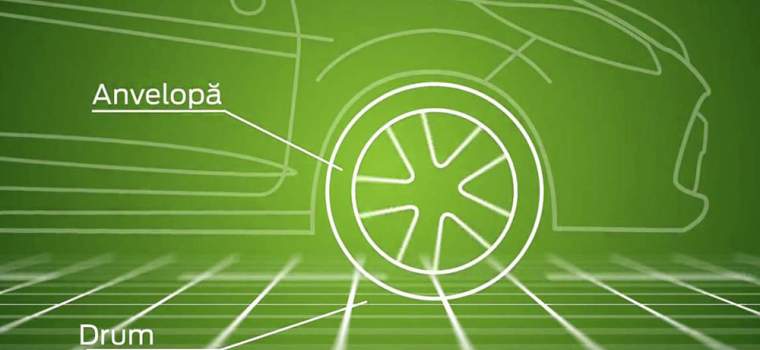
Why is it so important that the wheels do not lock? The wheels must not lock during braking because they must roll in order to have grip with the carriageway, the grip that makes the car go in the direction in which you want to steer. If the wheels are locked during braking, no matter how you turn the steering wheel left or right, the wheels not having grip, the car will continue to move straight ahead.
Most new cars are equipped with ABS. This system is always ready to operate, waiting for the moment to start acting, you do not have to press a button or something like that, once the motor vehicle is equipped with the ABS system it is always operational. When the ABS system is active you will feel in the brake pedal, when pressing hard, a small pulsation or sometimes you will hear the squeaking of the tires. Attention, never release the brake pedal when you feel this pulsation in the brake pedal, continue to press until the complete stop, do not be afraid, you will not damage the car in this way.
Something else, do not think that the ABS will perform miracles in any situation, if you are with all wheels on ice, do not think that the car will stop as if you were braking on a dry carriageway. But surely it will help you not to lose control of the car and not to enter uncontrolled skids as long as you adapt the travel speed to the road conditions.














Leave a comment