Driving in the rain.
Make sure you have good visibility by cleaning the windshield, the side windows, the rear window and also to make sure the windshield wipers, the air‑conditioning system and the defogging system are working properly.
The rain and the wet carriageway represent real dangers for the participants in traffic, most accidents in the rain occur due to the wrong habits of the drivers participating in traffic who many times totally ignore the weather. The unfavorable weather creating problems even for the most experienced drivers.
Turn on the headlights when it rains, even during the day, thus you will make yourself much more visible in traffic, preventing possible accidents.
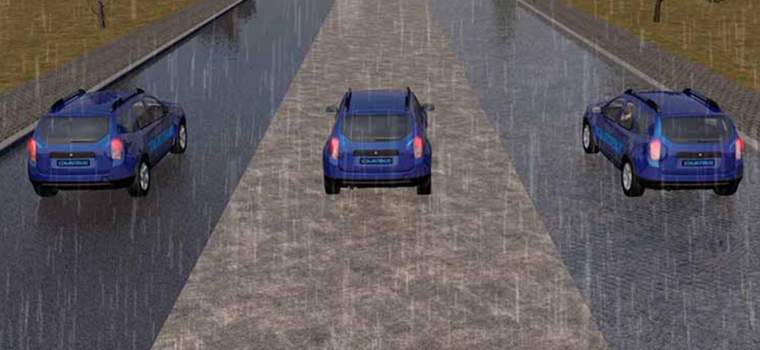
Increase the distance from the vehicle in front of you and do not forget, the grip is very low when it starts to rain or after a torrential rain. Usually you will drive on three types of carriageway: carriageway with asphalt surface, carriageway with concrete surface and carriageway with cobblestone. Among the three types of carriageway, the most dangerous in the rain is the cobblestone carriageway. This cobblestone is very slippery when it is wet. So be very careful when you drive on a wet cobblestone carriageway.
Be aware of the fact that the speed at which you drive is directly related to the braking distance. If at a speed of 50 km/h the complete stop is made in approximately 20 meters, at a speed of 100 km/h do not expect to stop in 40 meters, even if the travel speed has doubled, the braking distance does not increase proportionally with the travel speed. To completely stop the car at a speed of 100 km/h a braking distance of approximately 80 meters is necessary. And if you also consider the weather conditions you will really realize how important it is to drive preventively. So start braking in time when you want to stop and allow more time for slowing down before reaching a complete stop. The rain can lead to loss of tire grip when the brake is pressed suddenly.
Aquaplaning occurs when on the carriageway there is a layer of water which prevents the tire from having contact with the asphalt. In these conditions, the control of the motor vehicle becomes almost impossible. In general, aquaplaning appears when two situations meet: carriageway covered with water on large areas, and high travel speed of the motor vehicle.
Reduce the travel speed in the case of a wet carriageway. The travel speed must not exceed 30 km/h in the urban area and 50 km/h outside the urban area when visibility is reduced below 100 meters when it rains torrentially. Regulation for the implementation of OUG no.195/2002: Art. 123. – The driver of the vehicle is obliged to drive with a speed which must not exceed 30 km/h, in the urban area, or 50 km/h outside the urban area, in the following situations: k) when visibility is below 100 m in conditions of fog, torrential rains, heavy snowfalls.
Some questions that can fall in the official DRPCIV exam and which are related to the subject of the article above “driving in the rain”:
Which of the following types of carriageway is the most dangerous in rainy conditions?
A. the carriageway with asphalt surface;
B. the carriageway with concrete surface;
C. the carriageway with cobblestone.
DRPCIV video explanation here!
After a torrential rain, is it necessary to keep a considerably greater distance from the vehicle that is driving in front?
A. yes, since the braking distance increases;
B. no, since this leads to traffic congestion;
C. yes, because the signs cannot be seen.
DRPCIV video explanation here!














Leave a comment