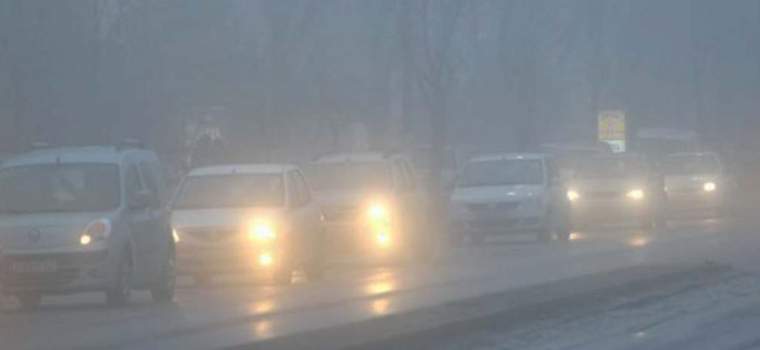
Fog dramatically reduces visibility, therefore the drivers must significantly reduce speed and increase attention. It is difficult to drive in dense fog, especially at night. So if you are a beginner, avoid driving long distances in dense fog conditions.
The most important thing. Turn on the rear fog light of the motor vehicle, this is a strong red light and its role is to make the motor vehicle visible from a greater distance when it is foggy. If the car is equipped with special fog front fog lights, turn them on as well, they will offer you better visibility, especially at night.
Fog can come in waves. It can very quickly change from a density where visibility is up to 100 meters to a density where you cannot see 10 meters ahead, in a very short interval. So increase attention, especially at night.
Never use the main beam (high beam) this will do nothing but worsen the situation, because the light hits directly into the fog forming a “wall of light”, visibility being much lower. Therefore many motor vehicles are equipped with special fog front fog lights, these are mounted so as to illuminate only downward, offering good visibility, not lighting the fog but only the carriageway. If the car is not equipped with special fog front fog lights, try to direct the headlights downward, toward the carriageway, it will not work wonders but it will help you somewhat.
Drive slowly and cautiously. The main cause of accidents is the failure to adapt speed to road conditions. So adapt the driving speed to the existing road conditions, this speed must not be greater than 30 km/h in the urban area and 50 km/h outside built-up area in dense fog. It is recommended to keep an approximately equal distance from the right-hand curb/shoulder and from the separation marking of the directions/lanes on the left.
Use the hazard warning lights if needed, to make yourself as visible as possible to the other traffic participants, when visibility is very low. As a rule, the hazard warning lights are used in three situations:
Among the three variants listed above, the situation exposed in foggy conditions by turning on the hazard warning lights is found at point 3.
Keep distance from the car in front of you, thus you will be able to avoid in time possible unforeseen situations. This safety distance should offer you the necessary time to stop. It is recommended that this distance be double the distance needed for stopping. For example if for the complete stopping of the motor vehicle you need 50 meters, the distance from the vehicle in front must be at least 100 meters.
Do not stop or wait on the carriageway. If you want to stop, look for a gas station or a side street or another safe place where you can stop in safety conditions, otherwise your car will become an almost invisible and very dangerous obstacle, both for you and for the other traffic participants.
1. In dense fog you have the obligation to use the low beam headlights and the fog lights, regardless whether you drive during the day or at night.
2. When visibility is reduced below 100 meters, in foggy conditions, you have the obligation to drive at a speed that does not exceed 30 km/h in the urban area and 50 km/h outside built-up area. Also the driving speed must be adapted to the road conditions, the road conditions can impose a speed limit even of 10-20 km/h.
3. Is prohibited the use of fog lights in other conditions than in fog.
At what speed will you drive in fog, torrential rain, heavy snow, if visibility is reduced below 100 m?
A. maximum 50 km/h in the urban area or 60 km/h outside built-up area;
B. reduce speed to the limit of avoiding any danger;
C. maximum 30 km/h in the urban area or 50 km/h outside built-up area.
DRPCIV video explanation here!
Is the use of fog lights allowed at night, if the sky is clear?
A. The Regulation does not specify;
B. yes;
C. no.
DRPCIV video explanation here!














Leave a comment