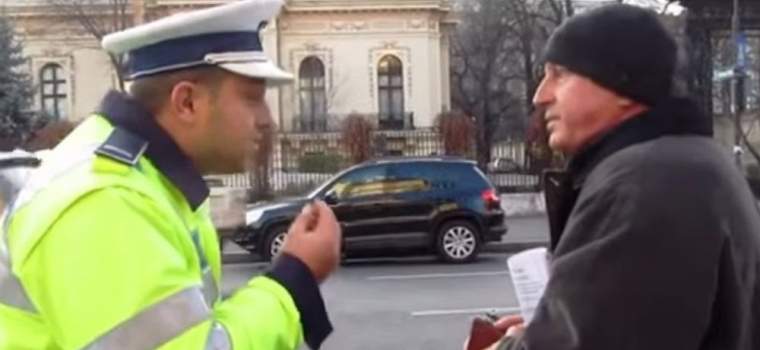
One of the most discussed issues among drivers in Romania is whether you are or are not allowed to take the police officer to task when you are stopped in traffic. Therefore, in this article we will clarify this confusion of many, helped of course by the letter of the law.
1. Is the traffic police officer obliged to identify himself in front of the driver?
Nothing more false, because if we read a little Law 218 of April 23, 2002 regarding the organization and functioning of the Romanian Police, at article 41 it is written that "in exercising the service duties the traffic police officer is obliged to present the badge or the service identification card, as the case may be, in order to make known, in advance, the status, except for the situations in which the result of the intervention or the further safety of the traffic police officer would be endangered."
In other words, as long as the officer has the badge on the chest, he is no longer obliged to show you the identification card.
2. The traffic police officer is not allowed to stop you in traffic without reason!
You have probably heard this many times, and most certainly you have also said it, but find out that it is false. "Government Decision no.1391/2006 for approving the Regulation for the application of the Government Emergency Ordinance no.195/2002 regarding traffic on public roads", specifies clearly at article 182 that "Stopping vehicles on public roads is carried out by performing the regulatory signals by the traffic police officer or, as the case may be, by the border police officer, when they find violations of traffic rules or in the situation where there are solid indications about committing a contravention or an act of criminal nature, for identifying the persons who have committed such acts and the goods that are the object of the search, as well as for verifying that the drivers of the vehicles hold the documents provided by the law. Stopping vehicles on public roads is also carried out in the conditions of natural calamities, disasters or other situations that endanger traffic safety."
3. Does the driver have the right to ask when he is stopped for the “service order” with information about the area and date of the checkpoint?
Well, this "urban legend" is also false. According to the legislation, the "service order" is a written instruction given by the management of a unit through which one or more salaried persons are asked to carry out certain actions, for a determined period, outside the current work duties of the compartments to which those persons belong.
Regarding the place, date and activity of the officers in the case of a checkpoint, all these are part of an internal instruction of secret character that can be checked only by the superior officers of the traffic police officer, not by any driver who suddenly believes he is a hero.
4. When you are stopped for the seat belt, for example, the police officer is not allowed to fine you for something else!
Practically there is no legal provision about this aspect, the finding of violations that break the legal norms being able to be done at any time. Meaning that if you are stopped because a headlight does not work, and the police officer notices other irregularities regarding documents, the condition of the car or, worse, of the driver, he can take the legal measures for each of them. It is logical that he does not stop you 10 meters further ahead to fine you for the rest of the irregularities.
5. In the case of a contravention report, you can sign that you have acknowledged the acts, but not that you also admit them!
First of all, you must know that this document has no special box in which you admit or not the acts, there is only the box "Other mentions". Here, the offender can request the recording of his opinions regarding the content of the finding act, such as possible objections or additions, etc. Lower on the form the offender signs because he has acknowledged the content of the contravention report and based on this signature receives a copy of the report.
Also, surely you have heard that if you do not sign, you can summon in court under legal assistance the police officer. This statement is also false, because the police officer who draws up the contravention report has no procedural capacity in the case of the contestation of the report, the party in such a process being the institution from which he is part, respectively the police unit/subunit. And this in turn will be represented by a legal adviser.
6. If the Traffic Police stop you and it seems to you that they make any abuse you can call 112 and “the police will come and draw up a report”!
The only thing you will get if you call 112 in this situation is a fine between 500 and 1,000 lei. Why? Because according to article 32 of O.U.G 34/2008, this is considered an abuse on your part.
Also in this normative act it is provided that calling the emergency number 112 is done ONLY for emergency situations. The fact that you are stopped by a police officer for control is NOT an emergency situation. Instead, violent acts can be reported to 112 if these come from the traffic police officer.
7. In the case in which you are stopped by a radar car, are you allowed to request different documents, including the metrological certificate?
Maybe you were told that when the radar stops you, you have the right to start requesting the officer’s identification card, a copy of the metrological certificate of the radar device, the identification card that proves that he has the right to drive the MAI car, or the service order.
Nothing more false. These documents have internal character, and their verification is done only by the hierarchical superior of the police officer.
At the same time, the Metrological verification certificate can be requested only by the court in case the offender files a contestation against the contravention report, and this document is sent in copy to the court, in no case to the sanctioned driver.














Leave a comment