



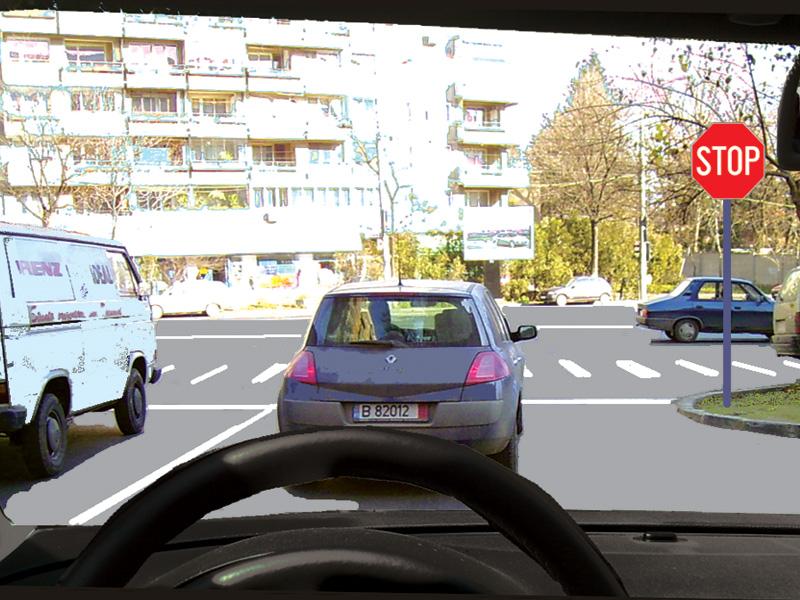
In the given situation you are approaching an intersection and you encounter the sign “Stop”. This sign obliges you to stop for making sure and to give priority to all vehicles that move in compliance with the traffic rules on the priority road. We draw attention that stopping at the sign “Stop” is obligatory, regardless of whether other vehicles are or are not moving at that moment on the priority road.
Considering that in this situation you encounter a pedestrian crossing, if there are pedestrians in the regular crossing of the road, on your direction of travel, you are obliged to give priority to them as well.
After stopping, making sure and giving priority you can cross the intersection.
In this situation you are NOT driving on a priority road. On the contrary, you are driving on a non-priority road, this is confirmed by the sign “Stop”.
You must never allow yourself to be influenced by the fact that the other road users have made sure and you must not rely entirely on the signals given by them. Always the checking will be done individually. Moreover, the sign “Stop” obliges to stopping, in which case you cannot enter the intersection together with the van and the car because this would mean not respecting the obligation to stop.
The correct answer is: A
Regulation** - Article 81
(1) The transverse marking consisting of a continuous line, applied on the width of one or more lanes, indicates the line before which the vehicle must be stopped when encountering the sign "Stop". Such a marking may be used to indicate the stopping line imposed by a light signal, by an order of the officer who directs the traffic, by the presence of a level crossing with a current railway, with a tram line or a pedestrian crossing. Before the marking that accompanies the sign "Stop" the inscription "Stop" may be applied on the carriageway.
[...]
** Regulation = REGULATION for the implementation of OUG 195/2002 updated (Traffic Code Regulation)

Leave a comment