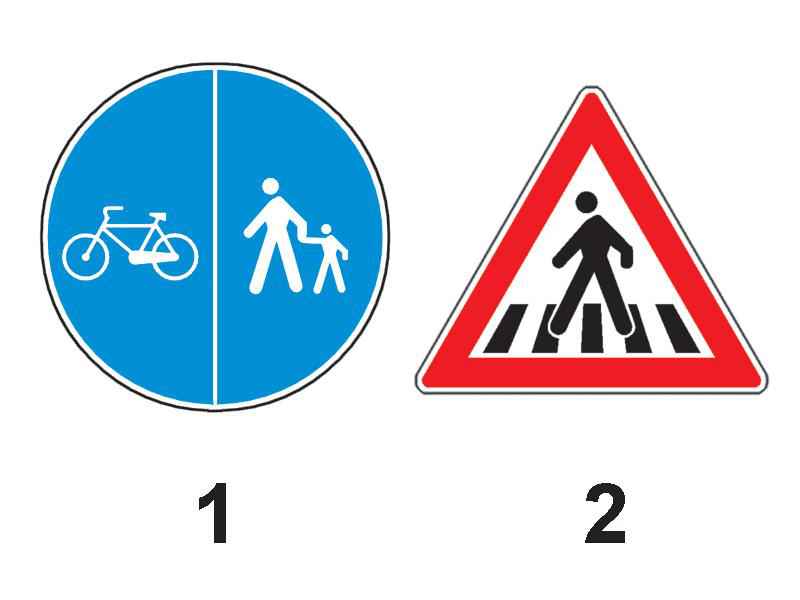
We draw attention to the fact that the question is “Which of the signs shown create obligations for the drivers of vehicles?” Attention! For the drivers of VEHICLES, not of motor vehicles.
Sign 1 is part of the category of mandatory signs and is called “Separation of pedestrian lanes from those intended for bicycles”. When encountering this sign, pedestrians and the drivers of bicycles or electric scooters are obliged to move only on the lane specific to the category they belong to, pedestrians on the pedestrian lane and bicycles and electric scooters on the bicycle lane. Therefore this sign creates obligations for the drivers of vehicles, more precisely for the drivers of bicycles or electric scooters, these being considered VEHICLES.
Sign 2 is part of the category of warning signs and is called “Advance warning of pedestrian crossing”. This sign warns you that at a distance between 50 and 250 meters there follows a pedestrian crossing. Since this is a warning sign, its role is to warn (to prevent) the drivers of vehicles about the presence of dangers on the road section ahead, more precisely about the presence of a pedestrian crossing. Therefore, this sign does not create obligations for the drivers of vehicles. Indeed the existence of a pedestrian crossing creates obligations for the drivers of vehicles, but the question refers to the warning sign in the image, it does not refer to the place that this sign warns about (the pedestrian crossing). Thus, the advance warning is only a warning, and the obligation to give priority to pedestrians applies only at the pedestrian crossing, which is marked and signalled accordingly with the “Pedestrian crossing” sign and sometimes also controlled by traffic lights.
The correct answer is: A
OUG* - Article 6
For the purposes of this emergency ordinance, the expressions and terms below have the following meanings:
[...]
6. motor vehicle - any vehicle equipped with a propulsion engine, usually used for transporting persons or goods on the road or for towing, on the road, vehicles used for transporting persons or goods. Vehicles that move on rails, called trams, as well as agricultural or forestry tractors are not considered motor vehicles. Trolleybuses are considered motor vehicles;
[...]
10. bicycle - the vehicle provided with two wheels, propelled by muscular force, with the help of pedals or cranks. Vehicles with pedals with assisted pedalling equipped with an auxiliary electric motor with a nominal continuous power less than or equal to 250 W, whose assistance is interrupted when the cyclist stops pedalling or is reduced progressively as the speed of the vehicle increases, being completely interrupted before the speed of the vehicle reaches 25 km/h, as well as motorised bicycles, as provided in Regulation (EU) no. 168/2013 of the European Parliament and of the Council of 15 January 2013 on the approval and market surveillance of two- or three-wheeled vehicles and quadricycles, are assimilated to the bicycle;
10^1. electric scooter - the vehicle with two or three wheels and handlebar, used for transporting a single person, which is not provided with a seat or which is equipped with a seat for the driver, whose reference seating point is at a height less than or equal to 540 mm in the case of those with two wheels, respectively at a height less than or equal to 400 mm in the case of those with three wheels, whose maximum speed by construction is greater than 6 km/h, but does not exceed 25 km/h and which is equipped with an electric motor; the reference seating point has the meaning provided in Regulation (EU) no. 168/2013 of the European Parliament and of the Council of 15 January 2013;
[...]
35. vehicle - the mechanical system that moves on the road, with or without self-propulsion means, usually used for transporting persons and/or goods or for performing services or works;
[...]
* OUG = GOVERNMENT EMERGENCY ORDINANCE no. 195 of 12 December 2002 updated (Road Traffic Code)















Leave a comment