



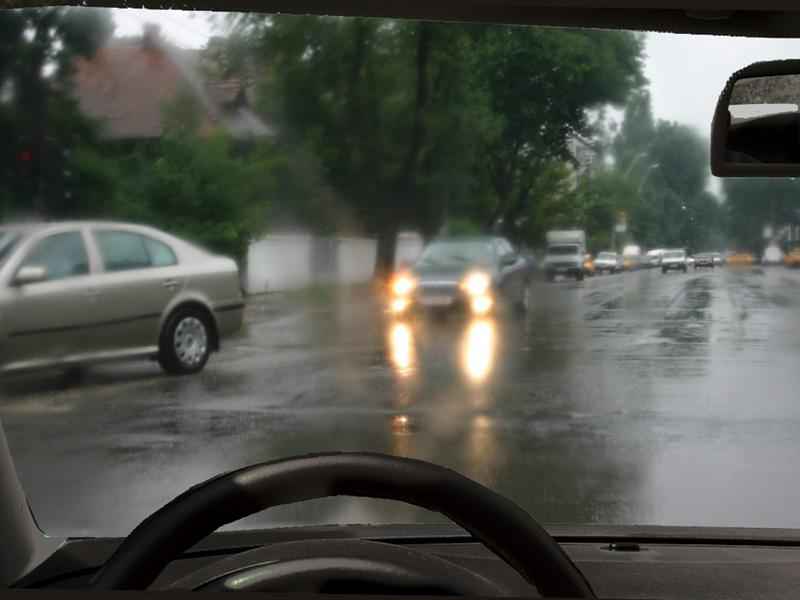
The drivers of motor vehicles, agricultural or forestry tractors and trams are obliged to use the low‑beam headlights (short beam) when it rains torrentially, snows heavily or in other conditions that reduce visibility on the road, regardless of whether driving takes place during the day or at night.
In the situation in the picture of the question it is observed that you are driving in torrential rain, in which case you have the obligation to drive with the low‑beam headlights (short beam) on, even if driving takes place during the day.
We want to emphasize the fact that, if before the rain started you had the daytime running lights (DRL) on instead of the low‑beam headlights (short beam), after the rain begins this option to use the daytime running lights (DRL) instead of the low‑beam headlights is no longer valid and it is mandatory to turn on the low‑beam headlights (short beam).
To better understand this rule we give the following example: A driver of a motor vehicle drives during the day, in optimal visibility conditions, in which case he is obliged to turn on either the low‑beam headlights (meaning the short beam), or the daytime running lights (DRL), as he considers, or he may even use both at the same time. But if he drives in torrential rain, heavy snowfall or in other conditions that reduce visibility on the road, the option to choose to turn on the daytime running lights (DRL) instead of the low‑beam headlights (short beam) IS NOT valid anymore because the road traffic legislation provides that in this case it is mandatory to use the low‑beam headlights (short beam), without leaving the option to use the daytime running lights (DRL) instead of the low‑beam headlights.
More information about the obligation to drive also during the day with the low‑beam headlights or with the daytime running lights on can be found here - The obligation to use the low‑beam headlights (short beam) or the DRL lights during the day.
The correct answer is: B
Regulation** - Article 114
(1) The drivers of motor vehicles, agricultural or forestry tractors and trams are obliged to use their lighting and/or signalling installations, as follows:
a) the position or parking lights when the vehicle is immobilized on the carriageway outside the urban area, from dusk until dawn, during the day when it rains torrentially, snows heavily or there is dense fog or in other conditions that reduce visibility on the public road;
b) the low‑beam or high‑beam headlights, in motion, both in the urban area and outside it, according to the degree of illumination of the public road;
[...]
e) the low‑beam headlights when it rains torrentially, snows heavily or in other conditions that reduce visibility on the road;
[...]
OUG* - Article 44
[...]
(2) In traffic on all categories of public roads the drivers of motor vehicles and agricultural or forestry tractors are obliged to use also during the day the low‑beam headlights or the daytime running lights. (Paragraph (2) was amended and updated on www.scoalarutiera.ro on 16‑06‑2023)
[...]
* OUG = EMERGENCY ORDINANCE no. 195 of 12 December 2002 updated (Road Traffic Code)
** Regulation = REGULATION for the implementation of OUG 195/2002 updated (Road Traffic Code Regulation)

Leave a comment