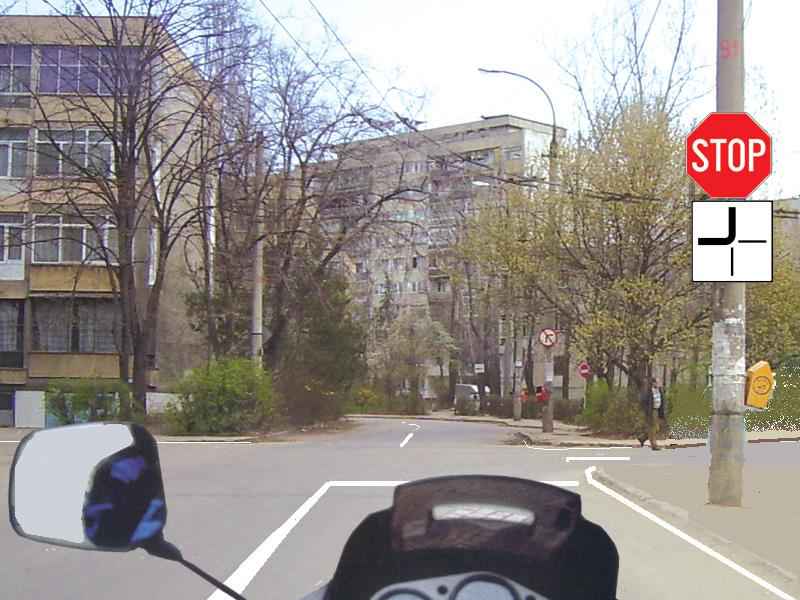
In this situation you intend to enter an intersection with traffic directed with regulatory priority signs and you encounter the “Stop” sign accompanied by the additional panel which indicates, through the thickened line, that the priority roads are the one on the left and the one in front.
The “Stop” sign obliges you to stop before the transverse stop marking applied on the carriageway and, while standing still, to give priority to the vehicles that come from the priority roads, more precisely the vehicles that come from the road on the left and the vehicles that come from the road in front.
The vehicles that come from the road on the right come from a non‑priority road, same as you, and you must also give priority to them because between the vehicle you are driving and the vehicles that come from the right a situation of equality is created, in which the rule of right‑hand priority will apply.
Therefore, when encountering the sign and the additional panel in the image, you will give priority to all the vehicles that move through the intersection.
The correct answer is: A
OUG* - Article 59
[...]
(2) In the intersections, the drivers of the vehicles that turn to the left are obliged to give priority to the vehicles with which they intersect and which move from the right.
(3) In the intersections with traffic directed by priority signs, the rule of right‑hand priority is respected only when two vehicles are about to meet, each entering the intersection from a road signalled with a sign having the same meaning of priority or loss of priority.
[...]
Regulation** - Article 129
(1) The vehicle that moves on a public road on which one of the signs having the meaning: “Priority road”, “Intersection with a non‑priority road” or “Priority over oncoming traffic” is installed has priority of passage.
(2) When two vehicles are about to meet in an intersection directed by signs, coming from two public roads where signs with the same meaning are installed, the vehicle that comes from the right has priority.
Regulation** - Article 81
(1) The transverse marking consisting of a continuous line, applied across the width of one or more lanes, indicates the line before which the vehicle must be stopped when encountering the “Stop” sign. Such a marking may be used to indicate the stop line imposed by a light signal, by an order of the officer who directs the traffic, by the presence of a level crossing with a railway, with a tram line or of a pedestrian crossing. Before the marking that accompanies the “Stop” sign, the inscription “Stop” may be applied on the carriageway.
[...]
* OUG = EMERGENCY ORDINANCE no. 195 of December 12, 2002 updated (Road Traffic Code)
** Regulation = REGULATION for the implementation of OUG 195/2002 updated (Regulation of the Road Traffic Code)








Leave a comment