OUG = GOVERNMENT EMERGENCY ORDINANCE no. 195 of December 12, 2002 (Road Code)
Regulation = REGULATION for the implementation of OUG 195/2002 (Road Code Regulation)
(1) Pedestrians are obliged to move only on the sidewalk, and in its absence, on the shoulder on the left side of the road, in their direction of travel. When the shoulder is also missing, pedestrians are obliged to move as close as possible to the left edge of the carriageway, in their direction of travel.
(2) Pedestrians have priority of passage over drivers of vehicles only when they are engaged in crossing public roads through specially designated places, marked and signalled accordingly, or at the green colour of the traffic light intended for pedestrians.
(3) The crossing of the public road by pedestrians is done perpendicular to its axis, only through places specially designated and signalled accordingly, and in the absence of these, in the urban area, at the corner of the street, only after they have made sure that they can do so without danger for them and for the other participants in traffic.
(4) Pedestrians surprised and injured as a result of crossing through forbidden places, at the red colour of the traffic light intended for them, or of failing to comply with other obligations established by the traffic rules bear the entire responsibility for their injury, provided that the driver of the respective vehicle has complied with the legal provisions regarding traffic through that sector.
(5) Persons who drive a wheelchair of special construction, those who drive vehicles intended exclusively for pulling or pushing by hand, those who move on skates or roller devices without self‑propulsion means, as well as those who drive vehicles whose maximum speed by construction does not exceed 6 km/h and are equipped with an electric motor are assimilated to pedestrians. (Paragraph (5) was modified and updated on www.scoalarutiera.ro on 11-02-2020)
(6) The traffic police officer and the persons who are on the platform of the public road and are authorised, in the exercise of their service duties, to guide or to direct road traffic, under the conditions established by the regulation, are exempted from complying with the rules established for pedestrians.
(7) It is prohibited the occupation of sidewalks with immobilized vehicles, and when this is permitted, according to signs or markings, the minimum width of the sidewalk left at the disposal of pedestrians must be at least one metre.
If you cannot/do not want to watch the AUDIO‑VIDEO version of the course, you can read the text version illustrated with images.
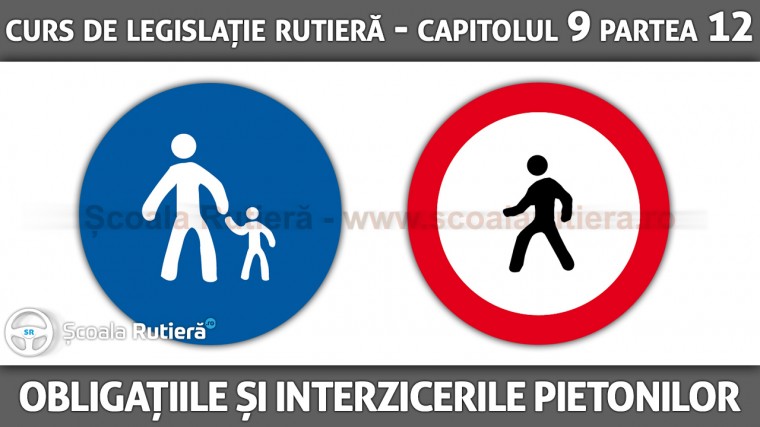
Pedestrians are obliged to move only on the sidewalk, and in its absence, on the shoulder on the left side of the road, in their direction of travel. When the shoulder is also missing, pedestrians are obliged to move as close as possible to the left edge of the carriageway, in their direction of travel (art. 72 paragraph 1 of the OUG).
Pedestrians have priority of passage over drivers of vehicles only when they are engaged in crossing public roads through specially designated places, marked and signalled accordingly, or at the green colour of the traffic light intended for pedestrians (art. 72 paragraph 2 of the OUG).
The crossing of the public road by pedestrians is done perpendicular to its axis, only through the places specially designated and signalled accordingly, and in the absence of these, in the urban area, at the corner of the street, only after they have made sure that they can do so without danger for them and for the other participants in traffic (art. 72 paragraph 3 of the OUG).
Pedestrians surprised and injured as a result of crossing through forbidden places, at the red colour of the traffic light intended for them, or of failing to comply with other obligations established by the traffic rules bear the entire responsibility for their injury, provided that the driver of the respective vehicle has complied with the legal provisions regarding traffic through that sector (art. 72 paragraph 4 of the OUG).
Persons who drive a wheelchair of special construction, those who drive vehicles intended exclusively for pulling or pushing by hand, those who move on skates or roller devices without self‑propulsion means, as well as those who drive vehicles whose maximum speed by construction does not exceed 6 km/h and are equipped with an electric motor are assimilated to pedestrians (art. 72 paragraph 5 of the OUG).
The traffic police officer and the persons who are on the platform of the public road and are authorised, in the exercise of their service duties, to guide or to direct road traffic, under the conditions established by the regulation, are exempted from complying with the rules established for pedestrians (art. 72 paragraph 6 of the OUG).
It is prohibited the occupation of sidewalks with immobilized vehicles, and when this is permitted, according to signs or markings, the minimum width of the sidewalk left at the disposal of pedestrians must be at least one metre (art. 72 paragraph 7 of the OUG).














Leave a comment