OUG = GOVERNMENT EMERGENCY ORDINANCE no. 195 of December 12, 2002 (Road Traffic Code)
Regulament = REGULATION for the implementation of OUG 195/2002 (Road Traffic Code Regulation)
(1) Traffic participants must show increased caution when approaching and crossing the current or industrial railway lines, as the case may be.
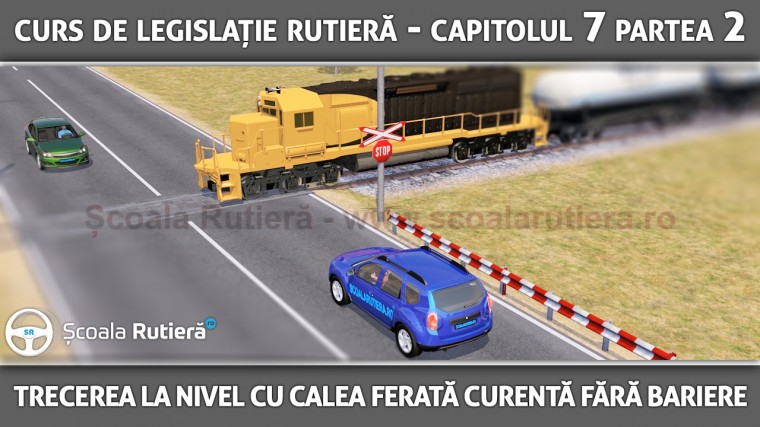
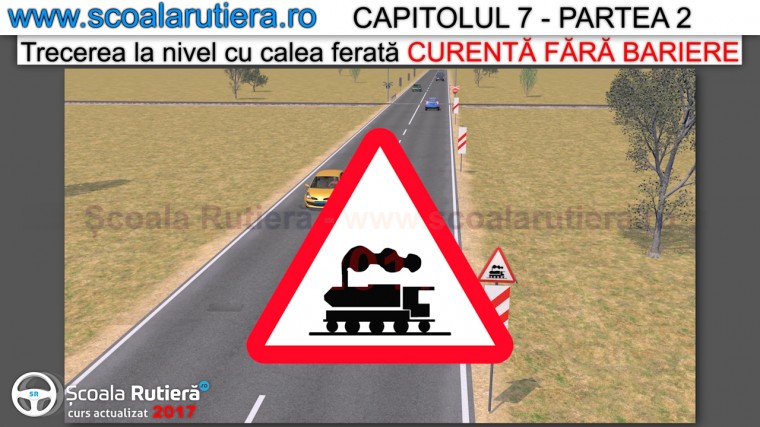
(1) The level crossing with the current railway without barriers or semibarriers is signalled, as the case may be, with the signs "Level crossing with single railway, without barriers" or "Level crossing with double railway, without barriers", accompanied by the sign "Stop".
(2) At the level crossing with the current railway provided with automatic signalling installations without barriers, the prohibition of road traffic is carried out, optically, by the operation of the devices with intermittent-alternative red lights and the extinguishing of the control signalling represented by intermittent white light and, acoustically, by the emission of intermittent sound signals.
(1) The signalling of the prohibition of road traffic is considered achieved even in only one of the following situations:
a) by the lighting of a single light unit of the device with intermittent-alternative red light;
b) by the operation of the sound system;
c) by the horizontal position of a single semibarrier.
(1) At the level crossing with the current railway, the driver of the vehicle is obliged to drive with reduced speed and to make sure that from the left side or from the right side no railway vehicle is approaching.
(1) The driver of the vehicle is obliged to stop when:
a) the barriers or semibarriers are lowered, in the process of lowering or raising;
b) the signal with red lights and/or the sound signal are operating;
c) he encounters the sign "Level crossing with single railway, without barriers", "Level crossing with double railway, without barriers" or "Stop".
(2) The vehicles must stop, in the order of arrival, in the place where there is maximum visibility over the railway without passing the signs provided in paragraph (1) letter c) or, as the case may be, before the stopping marking or before the barriers or semibarriers, when these are closed, in the process of lowering or raising.
If you cannot/do not want to watch the AUDIO-VIDEO version of the course, you can read the text version illustrated with images.
Is pre-signalled with the warning sign “Level crossing with railway without barriers”
This sign is installed:
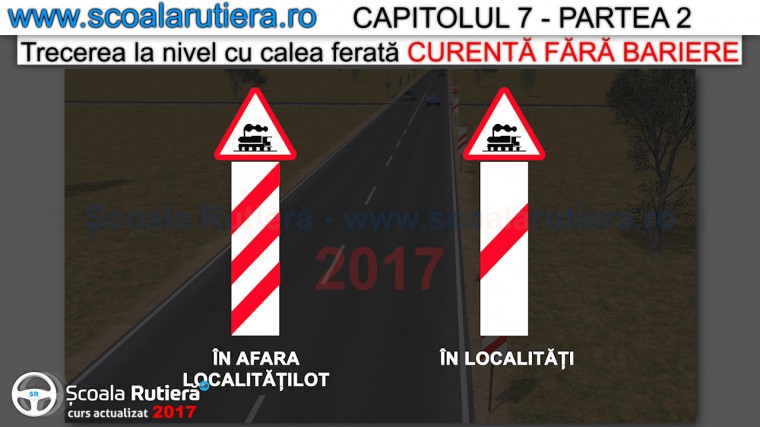
Is signalled with the following signs:
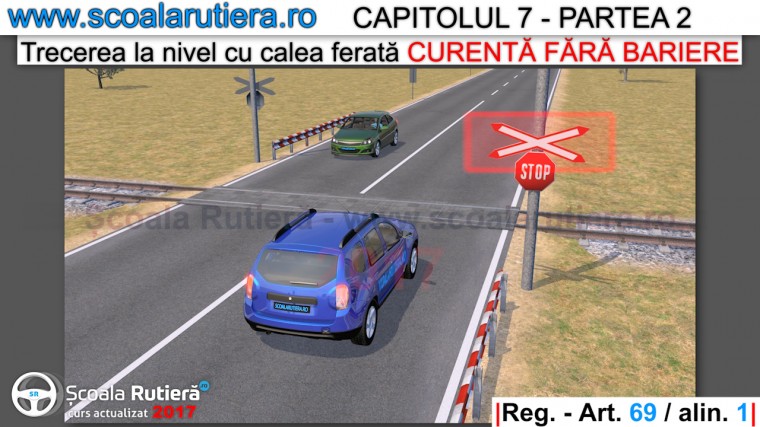
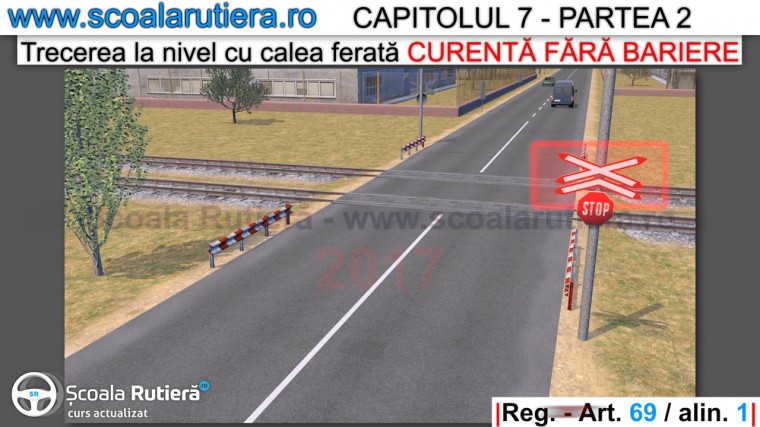
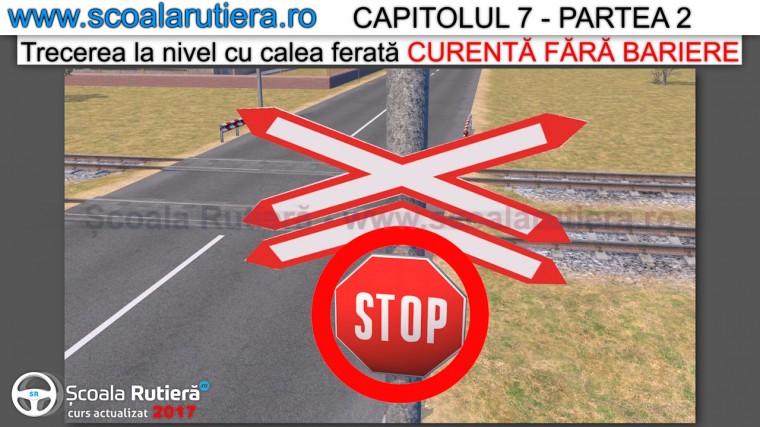
Is encountered at 6-10 meters from a level crossing with single or double railway, without barriers. These signs will also be accompanied by the sign „Stop”. (art. 69 paragraph 1 of the Regulation)
Stopping is mandatory regardless of whether at that moment any railway vehicle is circulating or not.
Stopping for ensuring is done also in the case in which the sign does not exist (missing, stolen, etc.).
Stopping is done individually, even if the vehicle in front has stopped and ensured.
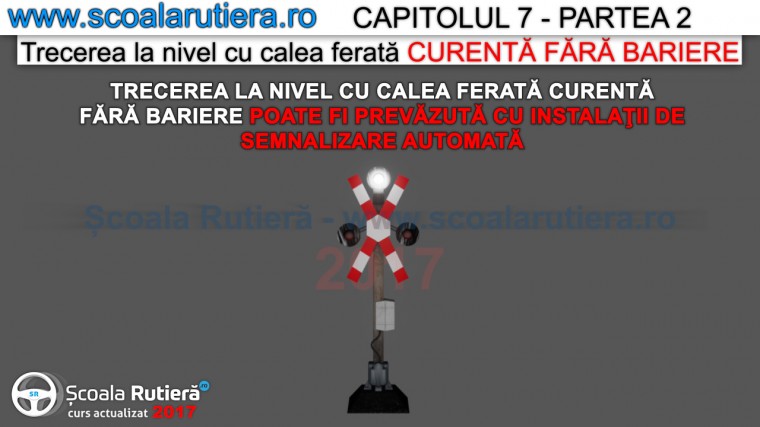
The signals have the following meaning (art. 69 paragraph 2 of the Regulation):
The lamp of white colour, which is placed in the upper middle part, operating intermittently, certifies the fact that the installation is functional and allows the crossing;
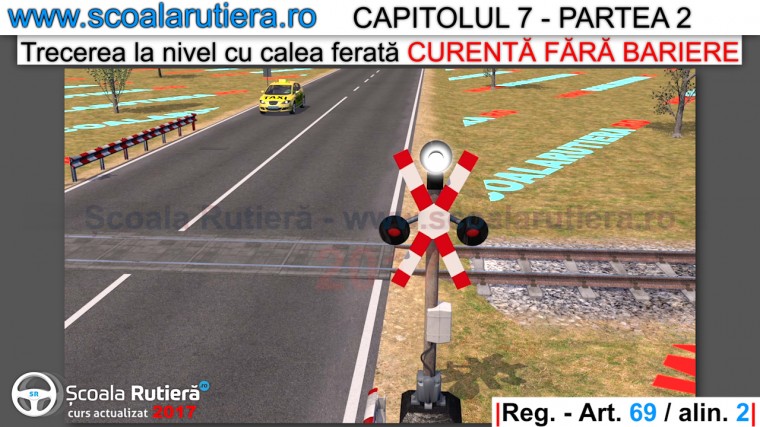
The lamps of red colour, which are placed laterally left and right, and through their alternative operation, as well as through acoustic warning, oblige the drivers of vehicles to stop;
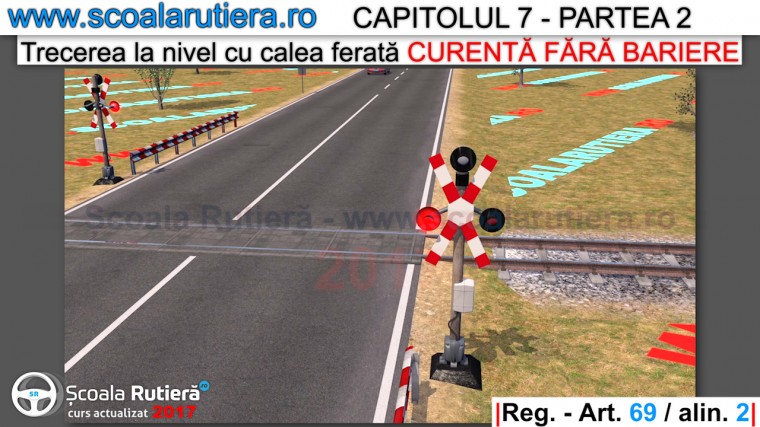
If only one of the lamps of red colour operates or if no lamp of red colour operates but the sound system operates, this obliges the drivers of vehicles to stop (art. 71 paragraph 1 of the Regulation).
If the signalling installation does not operate, the driver of the vehicle is obliged to stop, in the order of arrival, at the stopping marking, or in its absence, in the place where there is maximum visibility over the railway but without passing the sign (art. 138 of the Regulation). He makes sure that at that moment no railway vehicle is circulating, after which he may cross the railway. If at that moment a railway vehicle is approaching, he is obliged to wait for it to pass and after making sure that no other railway vehicle is circulating, may cross the railway.













Leave a comment