OUG = GOVERNMENT EMERGENCY ORDINANCE no. 195 of December 12, 2002 (Road Code)
Regulation = REGULATION for the implementation of OUG 195/2002 (Road Code Regulation)
7. traffic lane - the longitudinal subdivision of the carriageway, materialized by road markings or other means, if it has a width suitable for travel in one direction of a line of vehicles, other than vehicles that move on two wheels;
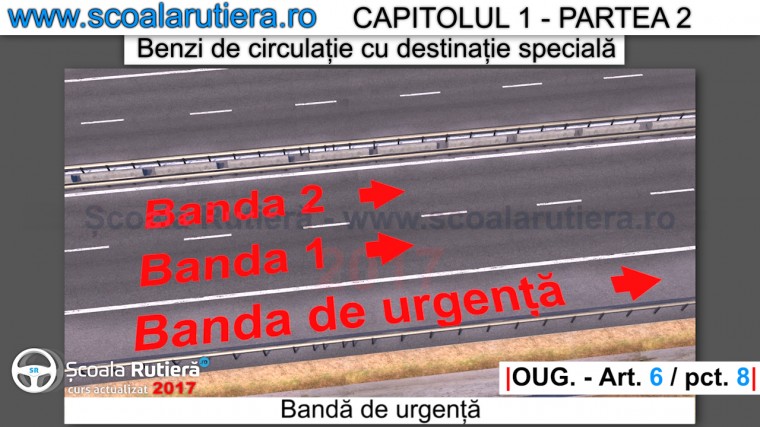
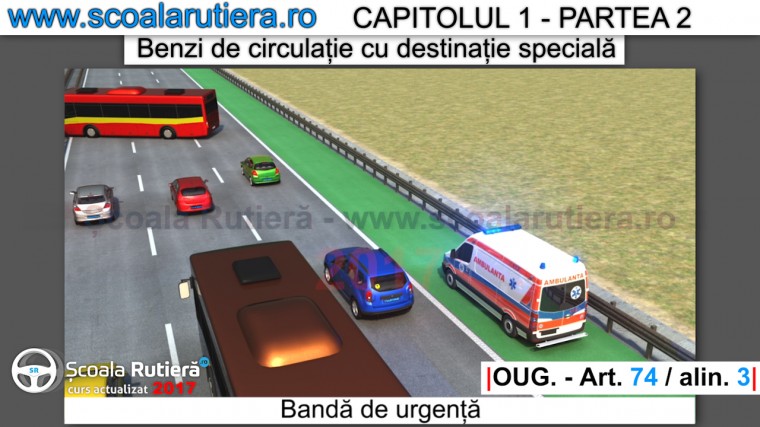
8. emergency lane - the additional longitudinal subdivision, located at the far right of the motorway, in the traffic direction, intended exclusively for the stopping of motor vehicles in justified cases, as well as for the movement of motor vehicles with priority regime that move to interventions or on missions of an emergency nature;
9. reversible lane - the traffic lane, marked and signalled, located next to the axis of the road, intended for the movement of motor vehicles in one direction or the other, depending on the traffic intensity;
(2) The numbering of the traffic lanes on each direction is carried out in increasing order from the right edge of the road towards its axis. In the case of motorways, the emergency lane is not included in the numbering of the traffic lanes.
(1) If a road is provided with a lane intended for slow vehicles or for public passenger transport, signalled as such, they will move only on that lane.
(3) Is prohibited the movement, stopping or waiting of motor vehicles on the emergency lane, except for justified cases, as well as for motor vehicles with priority traffic regime.
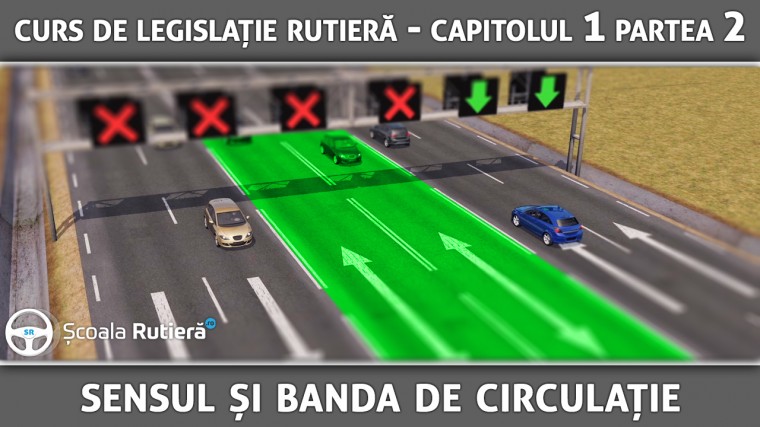
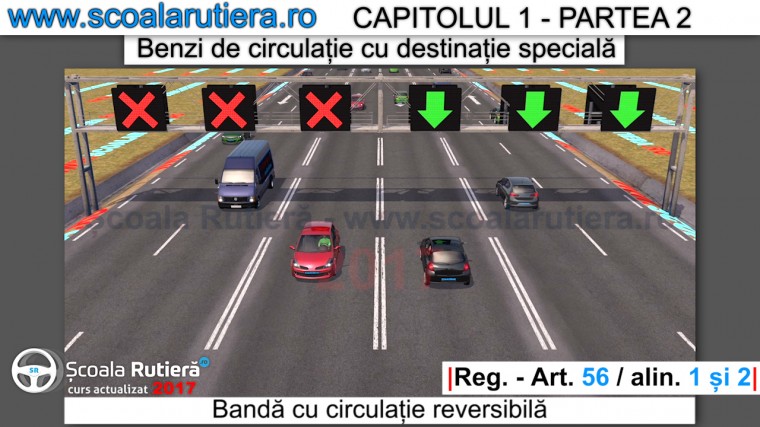
(1) When devices that emit red and green signals are installed above the traffic lanes, these are intended for signalling reversible lanes. The red signal, having the shape of two crossed bars, prohibits access of vehicles on the lane above which it is found, and the green signal, in the shape of an arrow pointing downwards, allows the entry of vehicles and travel on that lane.
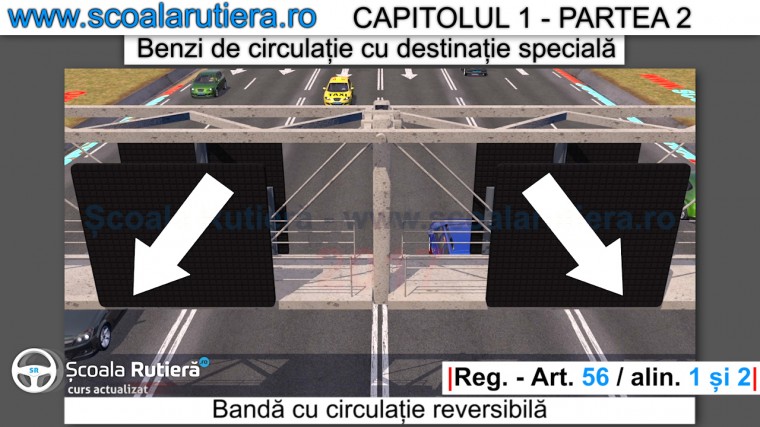
(2) The intermediate light signal which has the shape of one or more arrows of yellow or white colour with the tip oriented to the right or left down announces the change of the green signal, in the case of lanes with reversible traffic, or the fact that the lane above which it is located is about to be closed to the movement of the drivers they are addressed to, these being obliged to move on the lane or lanes indicated by the arrows.
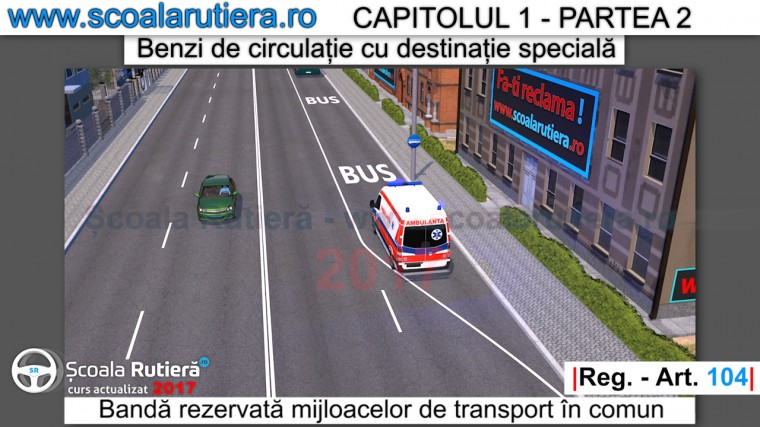
Vehicles that perform public passenger transport are driven on the lane reserved for them, if such a lane exists and is signalled as such. On the same lane may also move the motor vehicles with priority traffic regime when they move in intervention actions or in missions that have emergency character.
If you cannot/do not want to watch the AUDIO-VIDEO version of the course, you can read the text version illustrated with images.
The traffic direction: is the part of the public road on which all vehicles move in the same direction. The public road has two traffic directions, separated from each other by the axis of the road, which can be an imaginary line or can be materialized by a discontinuous or continuous longitudinal marking, single or double.
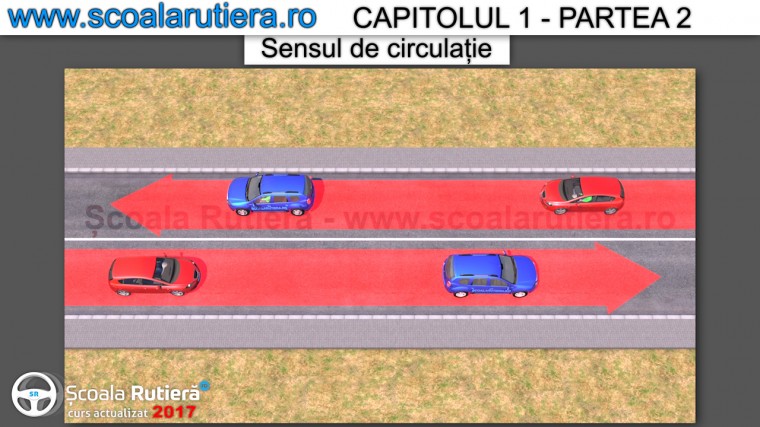
The axis of the public road must not be confused with the axis of symmetry of the road (the middle of the road). In most cases these coincide, but there are cases when the traffic directions are unequal.
In this example we have a public road with equal traffic directions, a situation in which the axis of the road is in the middle of the road and coincides with the axis of symmetry of the road.

In this example we have a public road with unequal traffic directions, a situation in which the axis of the road is no longer in the middle of the road and no longer coincides with the axis of symmetry of the road.

The traffic lane: the longitudinal subdivision of the carriageway, materialized by road markings, if it has a width suitable for travel in one direction of a line of vehicles, other than vehicles that move on two wheels (art. 6 pt. 7 of OUG).
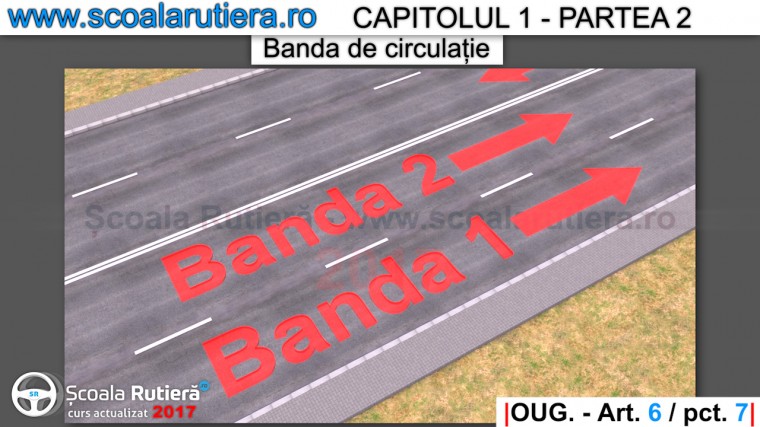
When the lanes are materialized, the public road has as many lanes as have been marked (one, 2, 3 or more).
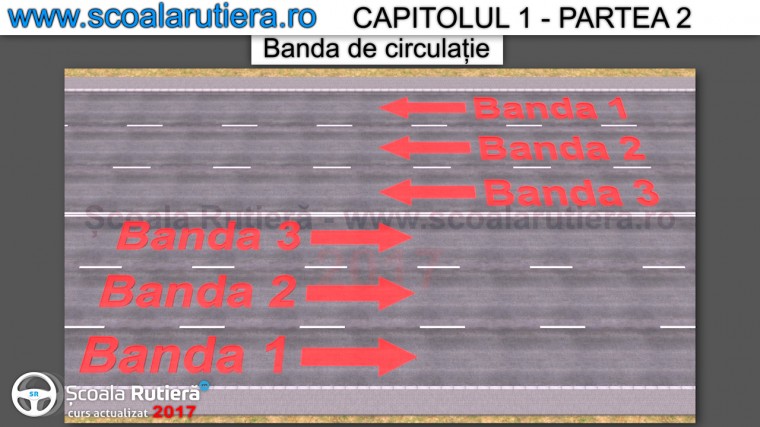
When the lanes are not materialized, they are called rows (lane=row).
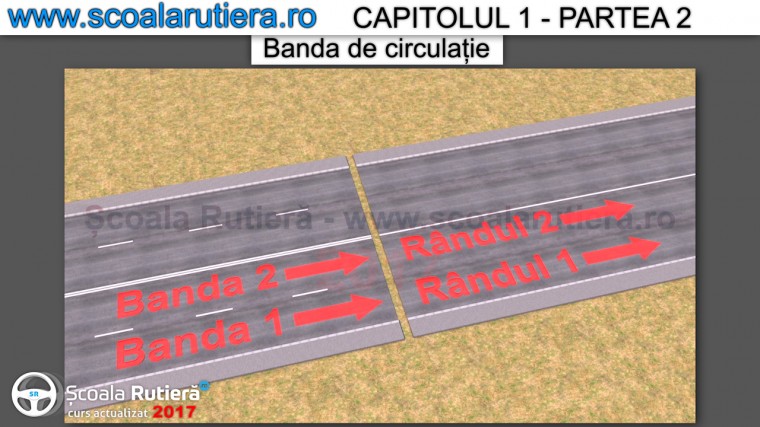

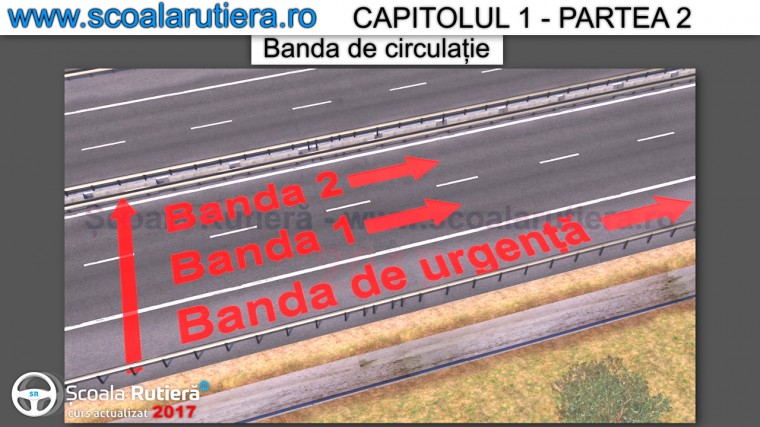
The numbering of the traffic lanes on each direction is carried out in increasing order from the right edge of the road towards its axis. In the case of motorways, the emergency lane is not included in the numbering of the traffic lanes (art. 41 paragraph 2 of OUG).

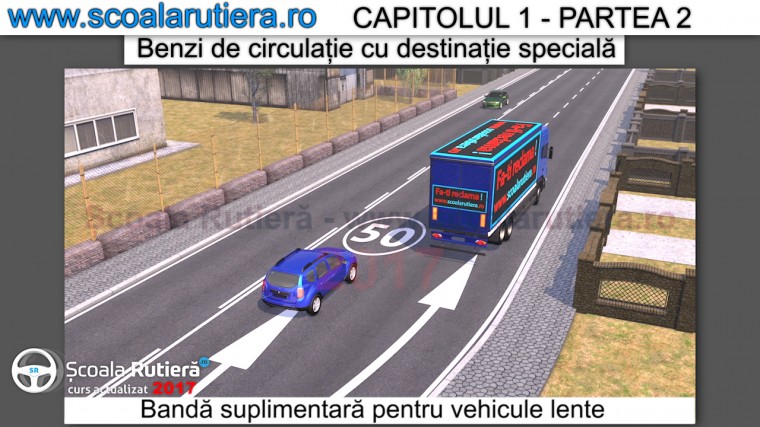
Additional lane for slow vehicles: is materialized by longitudinal marking, usually on uphill roads, for the fluidization of traffic, and helps vehicles that can move at higher speed not to be hindered in movement by vehicles with slow movement speed.
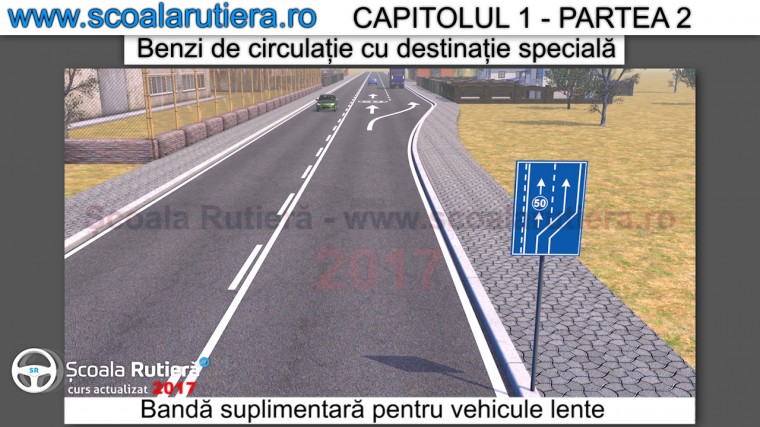
At the beginning of the road sector the sign “Lane intended for the movement of slow vehicles” is installed.
If a road is provided with a lane intended for slow vehicles, signalled as such, they will move only on that lane. (art. 43 paragraph 1 of OUG)
Lane reserved for public transport means: is materialized by longitudinal marking from continuous lines, on roads with several traffic lanes within built-up area. This creates the possibility for public transport means to move and enter stations without being hindered by the movement of the other vehicles. On this type of lanes, the other vehicles are not allowed to move, stopping and waiting being prohibited.
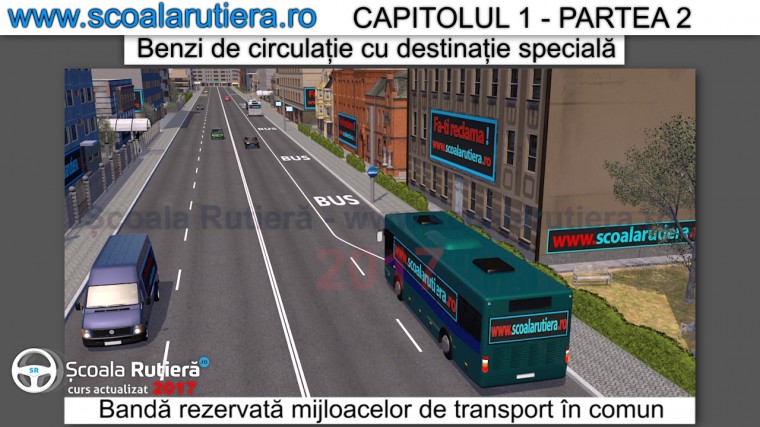
If a road is provided with a lane intended for public passenger transport, signalled as such, the vehicles that perform public passenger transport are driven only on the lane reserved for them. On the same lane may also move the motor vehicles with priority traffic regime when they move in intervention actions or in missions that have emergency character. (art. 104 of Regulation)
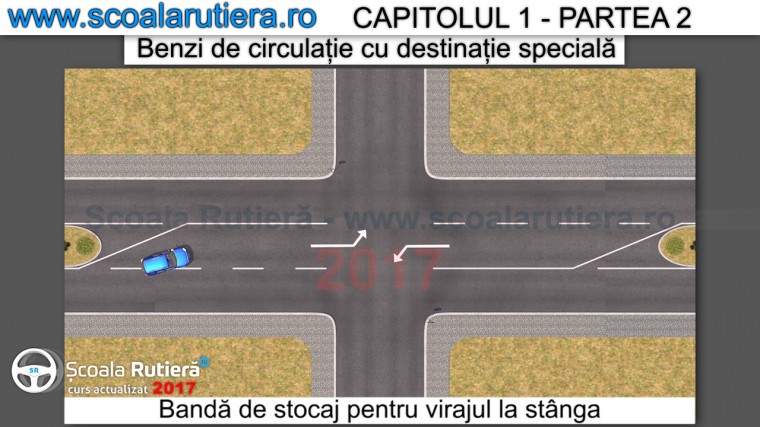
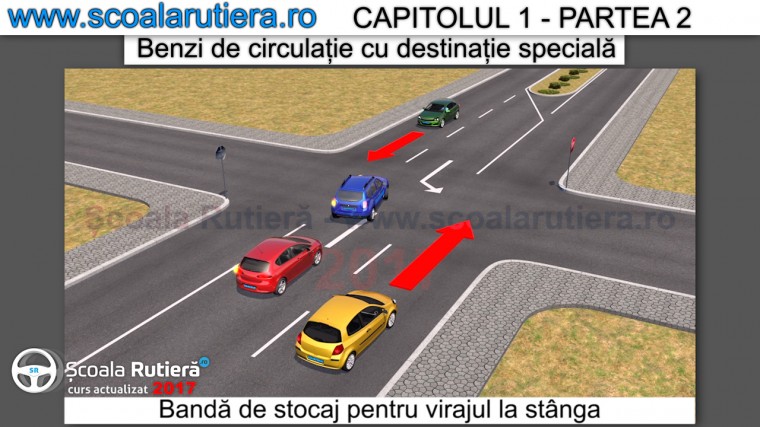
Storage lane for left turn: is materialized in the preselection area of intersections, for creating the possibility of executing the left turn, giving the possibility for the vehicles that turn left to stop and to give priority to the vehicles coming from the opposite direction, without hindering the movement of the vehicles that go straight ahead.
Deceleration lane: is materialized for creating the possibility of executing the right turn when the driver of vehicle, being obliged by law to reduce speed, would hinder the movement of the other vehicles that move straight ahead.
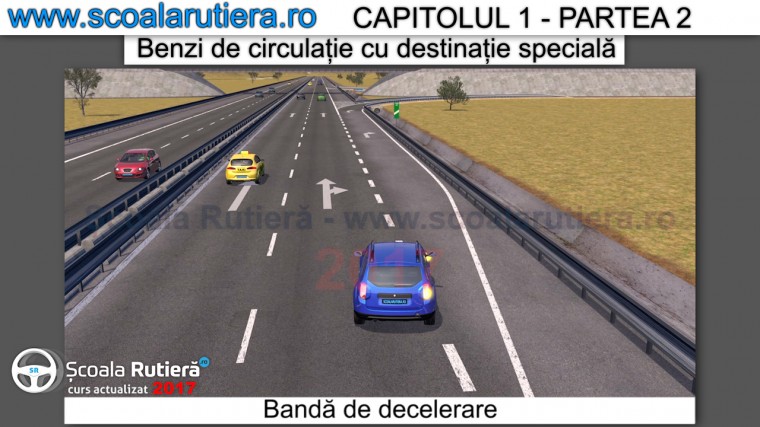
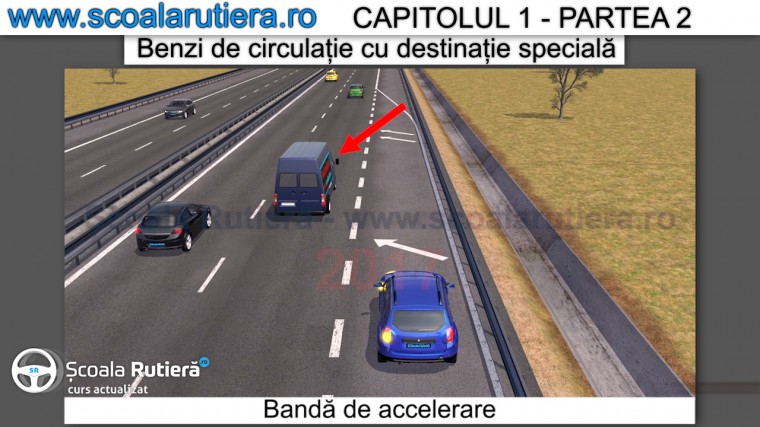
Acceleration lane: is materialized for creating the possibility of entering the heavily trafficked arteries, which have several traffic lanes. This lane creates the possibility for the drivers of vehicles that enter these arteries to be able to change the traffic lane without hindering the vehicles that already move on that lane, by reaching a higher speed or at least equal to the speed of those that move on the lane they want to enter.
Reversible traffic lane (art. 6 pt. 9 of OUG): is the traffic lane, marked and signalled, located next to the axis of the road, intended for the movement of motor vehicles in one direction or the other, depending on the traffic intensity.
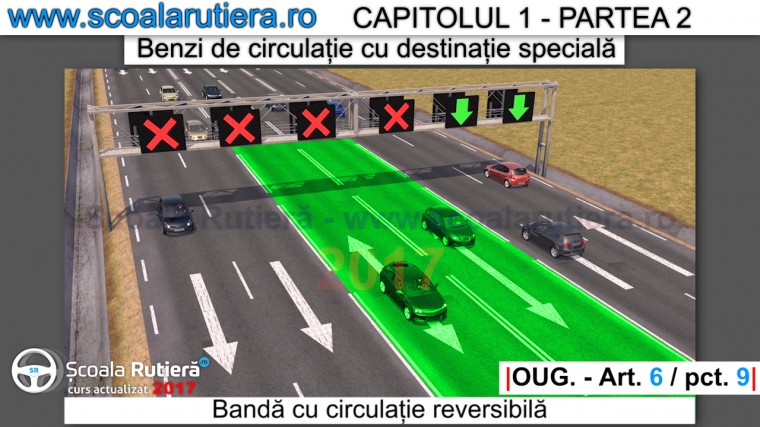
On these lanes the traffic direction is signalled by devices that emit light signals (art. 56 paragraph 1 and 2 of Regulation):
- The red signal, having the shape of two crossed bars, prohibits access of vehicles on the lane above which it is installed.
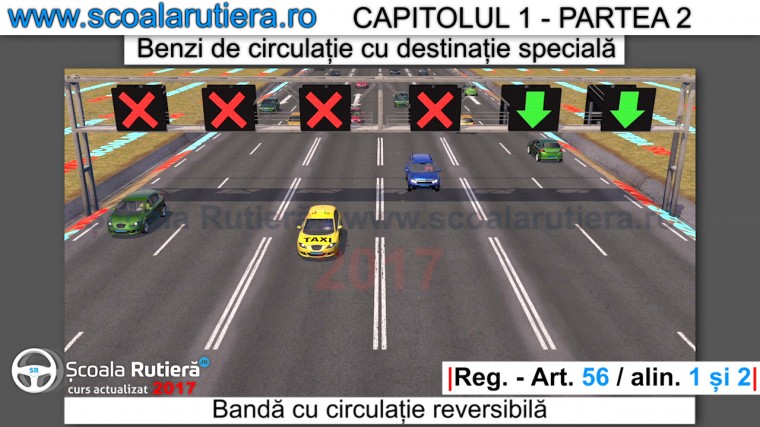
- The green signal, in the shape of an arrow pointing downwards, allows the entry of vehicles and travel on that lane.
- The signal that has the shape of one or more arrows of yellow or white colour with the tip oriented to the right or left, announces the change of the green signal, or the fact that the lane is about to be closed to traffic.
Emergency lane (art. 6 pt. 8 of OUG): is materialized only on motorways, having continuous longitudinal marking, located at the far right of the motorway. This lane is used only in case of emergency.
Is prohibited the movement, stopping or waiting of motor vehicles on the emergency lane, except for justified cases such as this situation in which the motor vehicle is waiting justified on the emergency lane for carrying out a tire puncture repair.
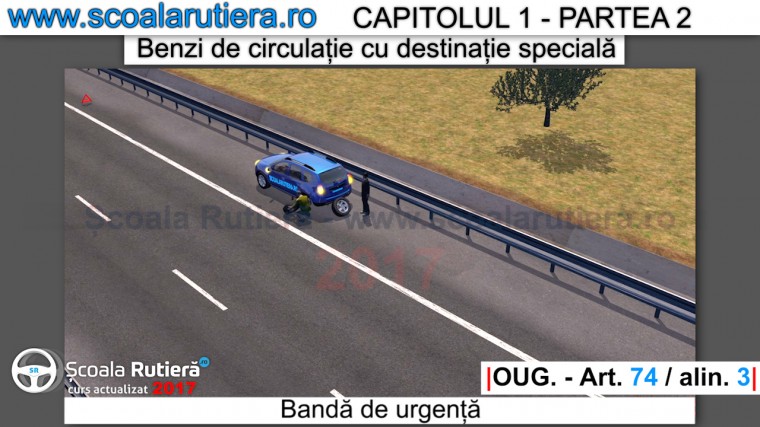
Exception also apply to the motor vehicles with priority traffic regime, these being able to move on this lane, when they move to interventions or in missions with emergency character. (art. 74 paragraph 3 of OUG)














Leave a comment