



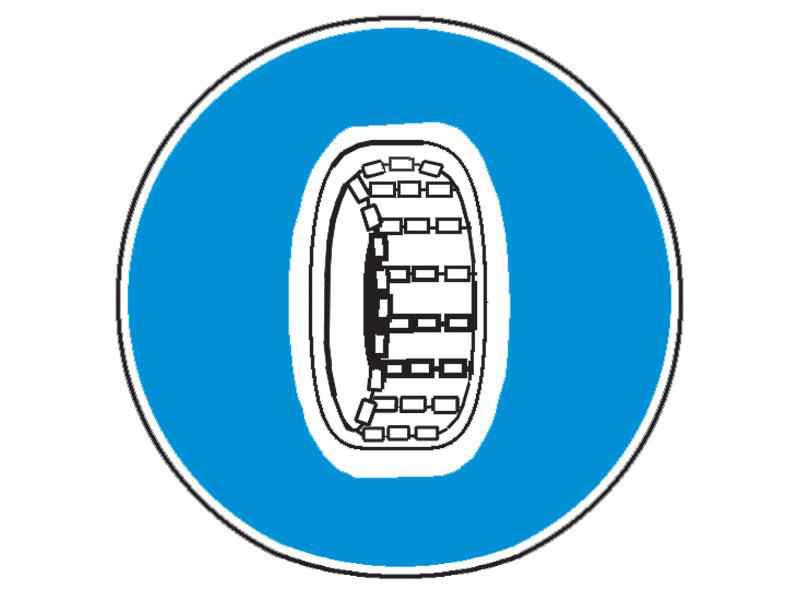
The sign is called “Snow chains”, this sign is encountered at the ends of road sections with pronounced slopes or tight curves where, when the carriageway is covered with snow, ice or black ice, it is mandatory for the vehicles to be equipped with anti-skid chains on at least two driving wheels. The obligation is valid regardless of the maximum authorised total mass of the vehicle. The “Snow chains” sign is accompanied by the additional panel “Black ice, ice, snow”. It can also be accompanied by the additional panel “The category of motor vehicles to which the sign refers” to specify for which category of motor vehicles the meaning of the sign is mandatory.
We must keep in mind that the road legislation, through Article 148, point 14 of the Regulation, obliges the drivers of motor vehicles with a maximum authorised total mass greater than 3.5 tonnes to equip these motor vehicles with winter tyres on the wheels of the traction axle/axles or, in the absence of winter tyres, with chains or other certified anti-skid equipment. It is important to remember that this article of law leaves, at choice, two options, either winter tyres on the wheels of the traction axle/axles, or chains or other certified anti-skid equipment applied on the summer tyres. However, the “Snow chains” sign leaves no option, it obliges the fitting with snow chains, regardless of whether the tyres are summer or winter.
The correct answer is: B
Regulation** - Article 148
Is prohibited the driver of the motor vehicle, agricultural or forestry tractor or tram:
[...]
14. to drive the motor vehicle with the maximum authorised total mass greater than 3.5 tonnes on roads covered with snow, ice or black ice, without having mounted on the wheels chains or other approved anti-skid equipment, in the periods and on the roads established by order of the minister of transport, construction and tourism;
[...]
** Regulation = REGULATION for the implementation of OUG 195/2002 updated (Road Traffic Code Regulation)

Leave a comment