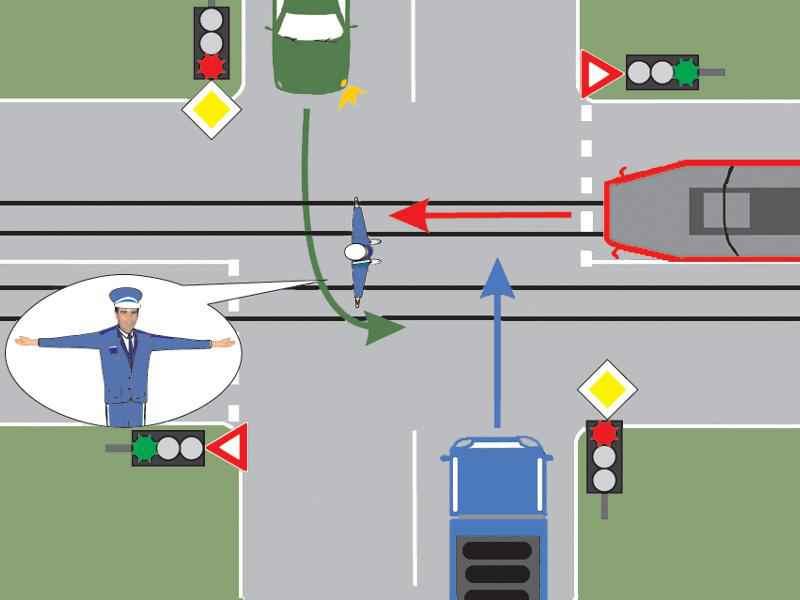
The traffic police officer performs a signal with the arms extended horizontally, this signal signifies stopping for all the participants in traffic whose initial direction of travel intersects with his arms, more precisely for those who move from the front and from the back of the traffic police officer. In this situation the initial direction of travel of the tram intersects with the left arm of the traffic police officer and must stop. The green car and the truck can continue their travel. Therefore in this situation the traffic police officer does not allow the passing of the tram.
The correct answer is: A
OUG* - Article 31
The participants in traffic must respect the traffic rules, the signals, the indications and the provisions of the traffic police officer, as well as the meaning of the different types of road signalling means, in the following order of priority:
a) the signals, the indications and the provisions of the traffic police officer;
b) the special warning signals, luminous or sound, of the motor vehicles, provided in art. 32 paragraph (2) letter a) and b);
c) the temporary signalling and/or the electronic signs, which modify the normal conduct of traffic;
d) the luminous or sound signals;
e) the signs;
f) the markings;
g) the traffic rules.
Regulation** - Article 88
(1) The signals of the traffic police officer who directs the traffic have the following meanings:
[...]
b) the arm or the arms extended horizontally signify "stop" for all the participants in traffic who, regardless of their direction of travel, move from the direction or the directions intersected by the arm or the arms extended. After giving this signal, the traffic police officer can lower the arm or the arms, the position meaning, as well, "stop" for the participants in traffic who come from in front or from behind;
[...]
* OUG = GOVERNMENT EMERGENCY ORDINANCE no. 195 of December 12, 2002 updated (Road Traffic Code)
** Regulation = REGULATION for the implementation of OUG 195/2002 updated (Regulation of the Road Traffic Code)















Leave a comment