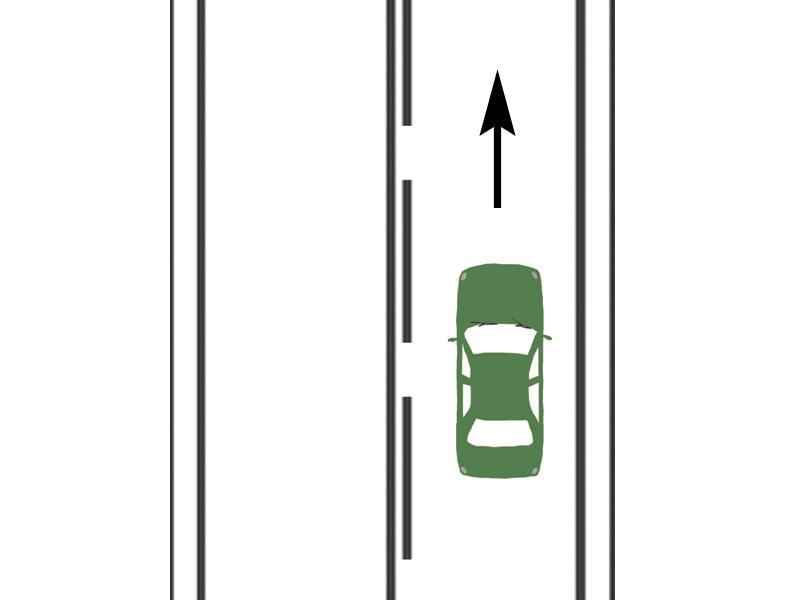
The longitudinal marking made of one broken line, single or double, allows crossing over it.
The longitudinal marking made of one continuous line, single or double, prohibits crossing it.
However, when the longitudinal marking is made of one continuous line and one broken line side by side, the driver of the vehicle must respect the meaning of the line that is closest in the direction of travel.
The longitudinal marking in the image is made of one continuous line and one broken line side by side. You are allowed to cross this marking and move onto the opposite direction of travel because the broken line is the closest to the vehicle you are driving.
It must be known that although the marking made of one broken line, single or double, allows crossing over it, you can do it only if the maneuver or the established regulations require this. For example, crossing it is allowed when performing the maneuver of changing the traffic lane, when performing the maneuver of changing the direction of travel or when performing the overtaking maneuver.
The correct answer is: B
Regulation** - Article 77
[...]
(2) The longitudinal marking made of one continuous line, single or double, prohibits crossing it.
[...]
Regulation** - Article 78
The longitudinal marking made of one broken line, single or double, allows crossing over it, if the maneuver or the established regulations require this.
Regulation** - Article 79
[...]
(3) In the case of the longitudinal marking made of one continuous line and one broken line side by side, the driver of the vehicle must respect the meaning of the line that is closest in the direction of travel.
[...]
** Regulation = REGULATION for the implementation of OUG 195/2002 updated (Road Traffic Code Regulation)















Leave a comment