



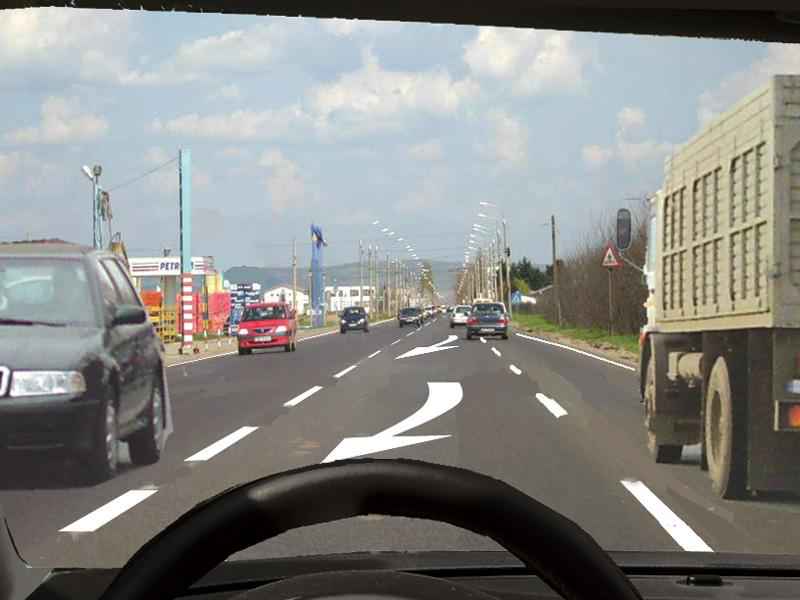
In the given situation you move on a road with three lanes and with two-way traffic. On this road, the lane at the far right of the road is intended for your direction, the lane at the far left of the road is intended for the opposite direction, and the middle lane is a lane that can be allocated alternatively to both directions. In this case the middle lane is allocated to the opposite direction. The arrows applied on the carriageway, on the middle lane, are folding arrows, arrows that are addressed to the vehicles that move from the opposite direction and that oblige them to leave the middle lane, passing on the lane indicated by these arrows. Therefore, the meaning of these folding arrows is not addressed to you.
You intend to perform the maneuver of overtaking the lorry using the middle lane and you encounter the longitudinal marking with discontinuous line that allows you to cross it and enter the middle lane to perform this maneuver. From the opposite direction no other vehicle approaches on this middle lane and you can continue performing the overtaking maneuver, the maneuver being performed in compliance with the traffic rules.
The correct answer is: C
OUG* - Article 6
[...]
7. traffic lane - the longitudinal subdivision of the carriageway, materialized by road markings or other means, if it has an appropriate width for the traffic in one direction of a row of vehicles, other than vehicles that move on two wheels;
[...]
Regulation** - Article 78
The longitudinal marking formed of a simple or double discontinuous line allows crossing over it, if the maneuver or the regulations instituted impose this.
Regulation** - Article 80
[...]
(4) The markings by arrows are used for:
[...]
c) folding, only outside the urban area on roads with one lane per direction and two-way traffic.
* OUG = GOVERNMENT EMERGENCY ORDINANCE no. 195 of December 12, 2002 updated (Road Traffic Code)
** Regulation = REGULATION for the implementation of OUG 195/2002 updated (Road Traffic Code Regulation)

Leave a comment