Explanation text category A / driving tests drpciv:
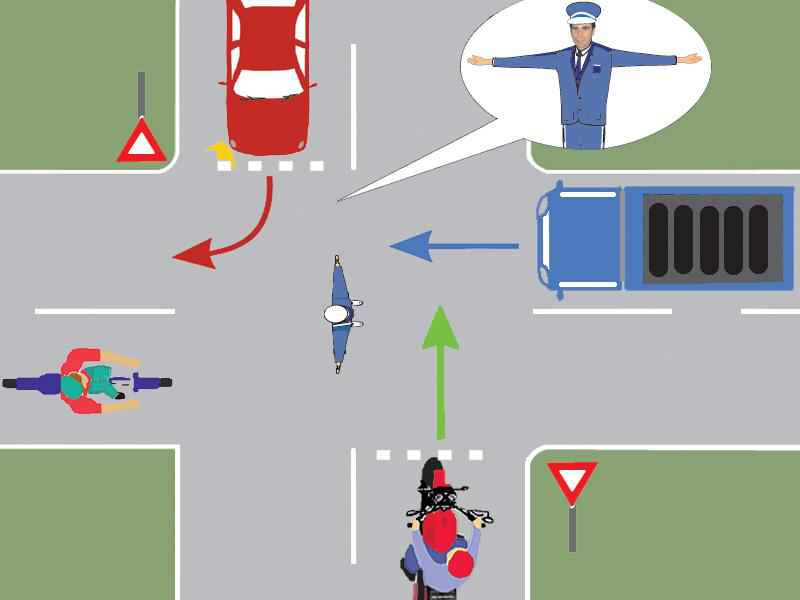
The traffic police officer performs a signal with the arms extended horizontally, this signal means stop for all participants in traffic whose initial direction of travel intersects with his arms, more precisely for those who travel from the front and from the back of the traffic police officer.
In the given situation, the initial direction of travel of the truck and of the bicycle intersects with the arms of the traffic police officer, these being obliged to stop.
The motorcycle and the car can continue their travel.
Therefore the correct answer is: C
Reference article from the road legislation in force: OUG or Regulation
Art. 88.
(1) The signals of the traffic police officer who directs the traffic have the following meanings:
a) the arm raised vertically means “attention, stop” for all participants in traffic who are approaching, except for the drivers of vehicles who could no longer stop in safety conditions. If the signal is given in an intersection, this does not impose the stop of the drivers of vehicles who are already engaged in crossing;
b) the arm or the arms extended horizontally mean “stop” for all participants in traffic who, regardless of their direction of travel, travel from the direction or directions intersected by the arm or the arms extended. After giving this signal, the traffic police officer can lower the arm or the arms, his position meaning, also, “stop” for the participants in traffic who come from the front or from the back;
c) the swinging, at night, in the vertical plane, of a device with red light or of the fluorescent‑reflective baton, means “stop” for the participants in traffic, towards whom it is directed;
d) the swinging on the vertical of the arm, having the palm oriented towards the ground, means the reduction of the speed;
e) the brisk rotation of the arm means the increase of the speed of travel of the vehicles or the hastening of the crossing of the road by the pedestrians.
(2) The traffic police officer who directs the traffic can perform a signal with the arm for the vehicle to advance, to overtake, to pass in front of or behind him, to avoid him on his left or right side, and for the pedestrians to cross the road or to stop.
(3) When performing the commands provided in paragraph (1) and (2), the traffic police officer can also use the whistle.
Leave a comment