OUG = GOVERNMENT EMERGENCY ORDINANCE no. 195 of December 12, 2002 (Road Traffic Code)
Regulation = REGULATION for the implementation of OUG 195/2002 (Road Traffic Code Regulation)
(1) Overtaking is the maneuver by which a vehicle passes in front of another vehicle or by an obstacle, located on the same direction of travel, by changing the direction of travel and leaving the traffic lane or the row of vehicles in which it was initially.
(2) The driver of the vehicle who engages in overtaking must make sure that the vehicle traveling in front or behind him has not initiated such a maneuver.
(3) When by the overtaking maneuver the axis which separates the directions of travel is crossed, the drivers of vehicles must make sure that from the opposite direction no vehicle is approaching and that they have sufficient space to re-enter the initial lane, where they have the obligation to return after performing the overtaking maneuver.
(4) It does not constitute overtaking, within the meaning of paragraph (1), the situation in which a vehicle moves faster on one of the lanes than the vehicles moving on another lane in the same direction of travel.
(5) Overtaking is carried out only on the left side of the overtaken vehicle. The tram or the vehicle whose driver has signalled the intention and has moved into position accordingly for leaving the direction of travel to the left is overtaken on the right side.
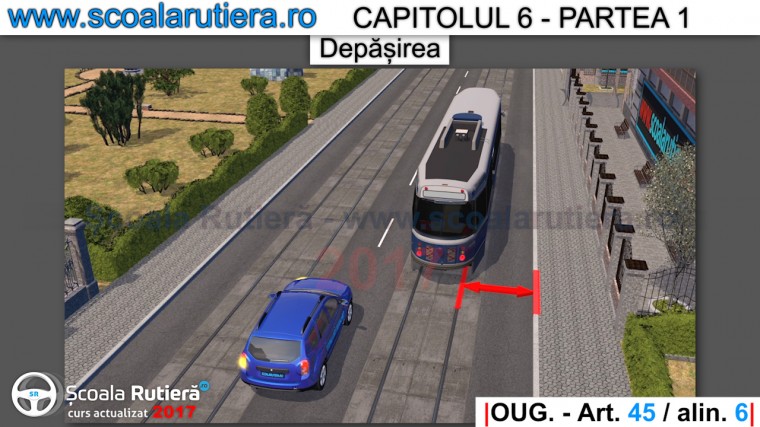
(6) The tram in motion may also be overtaken on the left side when the road is one-way or when between the right rail and the edge of the sidewalk there is not enough space.
(1) The driver of a vehicle who performs a maneuver of changing the direction of travel, of leaving a row of parked vehicles or entering such a row, of moving to another traffic lane or turning right or left or who is going to perform a U-turn or to move in reverse is obliged to signal in time and to make sure that he can do so without disturbing the traffic or endangering the safety of the other traffic participants.
(2) Signalling the change of direction of travel must be maintained for the entire duration of the maneuver.
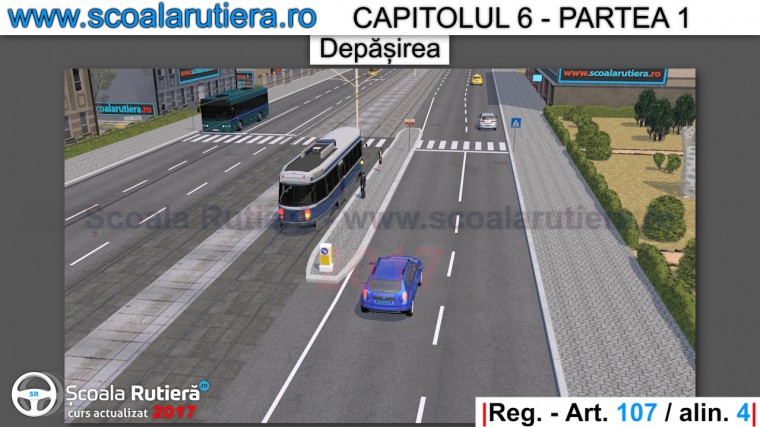
(4) In the case in which the tram is stopped in a station without a refuge for pedestrians, the vehicles must stop in the order of arrival, behind it, and resume their travel only after the doors of the tram have been closed and they have made sure that they do not endanger the safety of the pedestrians engaged in crossing the public road.
(1) The drivers of vehicles are obliged to signal the change of direction of travel, overtaking, stopping and setting in motion.
(2) The intention of the drivers of motor vehicles, agricultural or forestry tractors and trams to change the direction of travel, to leave a row of parked vehicles or to enter such a row, to move to another traffic lane or to turn right or left or those who are going to perform a U-turn, overtaking or stopping is signalled by activating the direction indicator lights at least 50 m in the urban area and 100 m outside built-up areas before starting the performance of the maneuvers. (Paragraph (2) was modified and updated on www.scoalarutiera.ro on 06-10-2021)
(1) The driver of a vehicle who performs overtaking is obliged:
a) to make sure that the one who follows him or precedes him has not signalled the intention of starting a similar maneuver and that he can overtake without endangering or without hindering the traffic from the opposite direction;
b) to signal the intention of performing the overtaking;
c) to keep during the overtaking a sufficient lateral distance from the overtaken vehicle;
d) to re-enter the lane or in the row of traffic in which he was initially after he has signalled and has made sure that he can perform this maneuver in safety conditions for the overtaken vehicle and for the other traffic participants.
(2) For ensuring the lateral safety distance, at overtaking a bicycle or an electric scooter the drivers of motor vehicles, other than those which move on two wheels, perform this maneuver by crossing the longitudinal marking of separation of the directions of travel or of separation of the lanes on the same direction, with at least half of the width of the motor vehicle when its speed is greater than 50 km/h, or at least by violating these markings when the travel speed is up to 50 km/h. (Paragraph (2) was modified and updated on www.scoalarutiera.ro on 06-10-2021)
The driver of a vehicle who is going to be overtaken is obliged:
a) not to increase the travel speed;
b) to travel as close as possible to the right edge of the carriageway or of the lane on which he is moving.
(1) Is prohibited the overtaking of vehicles:
a) in intersections with undirected traffic;
b) near the top of a slope, when visibility is reduced below 50 m;
c) in curves and in any other places where visibility is reduced below 50 m;
d) on uneven passages, on bridges, under bridges and in tunnels. By exception, in these places may be overtaken the animal-drawn vehicles, motorcycles without sidecar, mopeds, bicycles and electric scooters, if the visibility over the road is ensured for a distance greater than 20 m, and the width of the road is at least 7 m; (Letter d) of Paragraph (1) was modified and updated on www.scoalarutiera.ro on 06-10-2021)
e) on pedestrian crossings signalled by signs and markings;
f) on level crossings with the current railway and at less than 50 m before them;
g) at the tram station, when it is stopped, and the station is not provided with a refuge for pedestrians;
h) in the action area of the sign "No overtaking";
i) when for performing the maneuver the continuous marking, simple or double, which separates the directions of travel, is violated, and the motor vehicle moves, even partially, on the opposite direction, or the marking which delimits the space of prohibition is violated;
j) when from the opposite direction another vehicle is approaching, and its driver is obliged to perform maneuvers to avoid the collision;
k) on the road section where a queue of vehicles in waiting has formed, if by this the opposite direction of travel is entered.
(2) Is prohibited the overtaking of the official convoy.
If you cannot/do not want to watch the AUDIO-VIDEO version of the course, you can read the illustrated text version with images.

The maneuvers performed on the public road are:
The intention of the drivers of motor vehicles, agricultural or forestry tractors and trams to change the direction of travel, to leave a row of parked vehicles or to enter such a row, to move to another traffic lane or to turn right or left or those who are going to perform a U-turn, overtaking or stopping is signalled by activating the direction indicator lights at least 50 m in the urban area and 100 m outside built-up areas before starting the performance of the maneuvers. The distance of at least 50 meters in the urban area and 100 meters outside built-up areas means the distance between the place where we signal the intention to perform the maneuver and the place where the maneuver begins, more exactly the distance traveled with the indicator light on until you begin performing the maneuver (art. 116 paragraph 1 and 2 of the Regulation)
They are obliged to signal in time the maneuvers they intend to perform and to make sure that they can perform them without disturbing the traffic or endangering the safety of the other traffic participants (art. 54 paragraph 1 of OUG).
Signalling the change of direction of travel must be maintained in operation for the entire duration of the maneuver (art. 54 paragraph 2 of OUG).
Overtaking is the maneuver by which a vehicle passes in front of another vehicle or by an obstacle, located on the same direction of travel, by changing the direction of travel and leaving the traffic lane or the row of vehicles in which it was initially (art. 45 paragraph 1 of OUG).

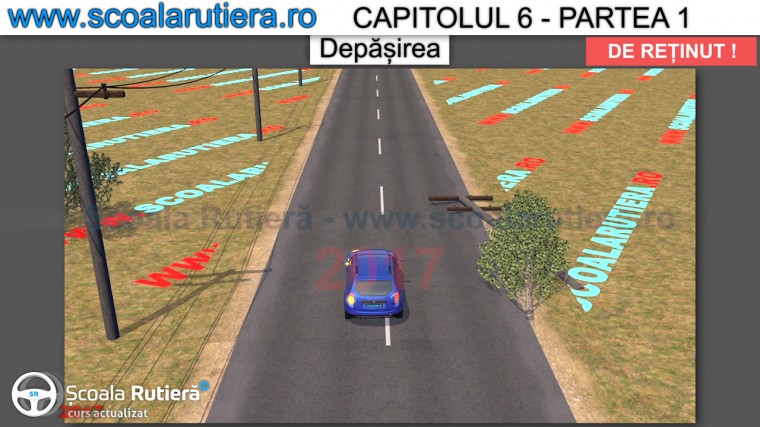

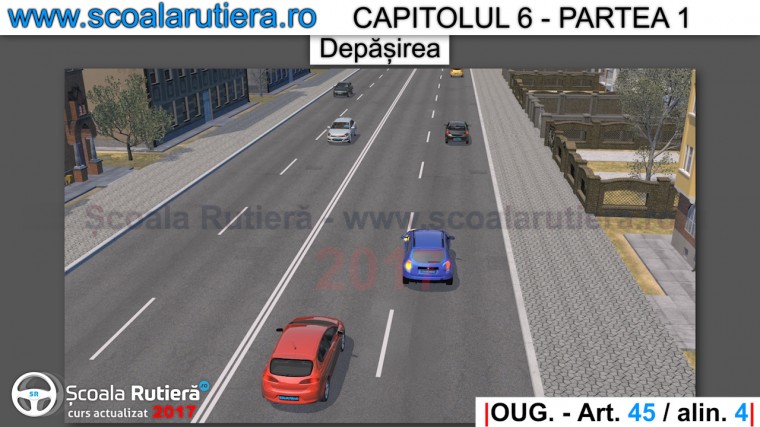
It does not constitute overtaking if on a road with two or more traffic lanes for each direction, a vehicle moves faster on one of the lanes than the vehicles moving on another lane in the same direction of travel (art. 45 paragraph 4 of OUG).

If, on a road with two or more traffic lanes for each direction, the vehicle on lane 1 passes in front of the vehicle on lane 2, it is not considered overtaking on the right side, it is considered changing the traffic lane.
The driver of the vehicle who engages in overtaking must make sure that the vehicle traveling in front of him or behind him has not initiated such a maneuver (art. 45 paragraph 2 of OUG).
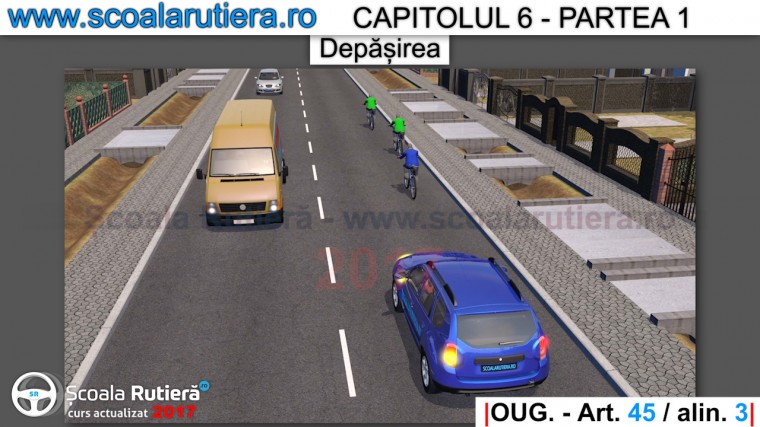
When by the overtaking maneuver the axis which separates the directions of travel is crossed, more exactly when the opposite direction of travel is entered, the drivers of vehicles must make sure that from the opposite direction no vehicle is approaching and that they have sufficient space to re-enter the initial lane, where they have the obligation to return after performing the overtaking maneuver (art. 45 paragraph 3 of OUG).
Overtaking is carried out only on the left side of the overtaken vehicle.
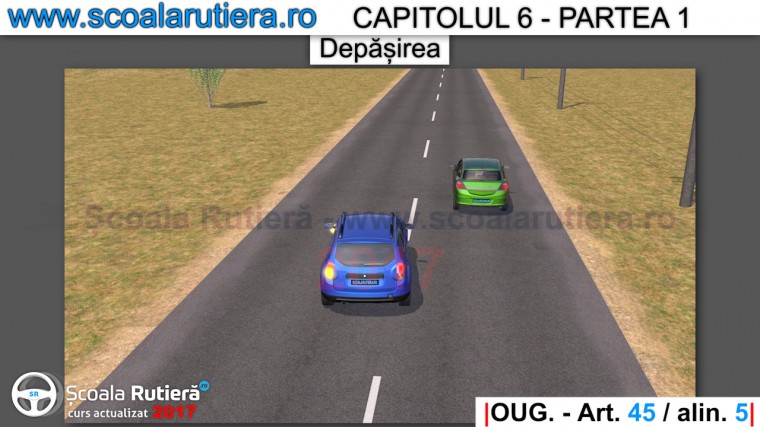
The vehicle whose driver has signalled the intention to turn left and has moved into position accordingly is overtaken on the right side, if the remaining lateral space allows you to perform the maneuver (art. 45 paragraph 5 of OUG).
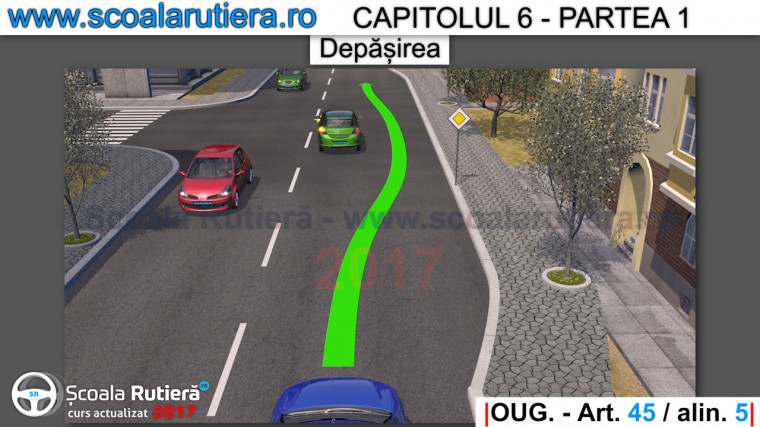
The tram is overtaken usually on the right side (art. 45 paragraph 5 of OUG).

The tram in motion may also be overtaken on the left side (art. 45 paragraph 6 of OUG):

The tram stopped in a station with a refuge for pedestrians is overtaken on the right side. But when the tram is stopped in a station without a refuge for pedestrians, regardless whether the road has two-way traffic or one-way traffic, it is not overtaken and the vehicles must stop in the order of arrival, behind it, and resume their travel only after the doors of the tram have been closed and they have made sure that they do not endanger the safety of the pedestrians engaged in crossing the public road (art. 107 paragraph 4 and art. 120 paragraph 1 letter g of the Regulation).

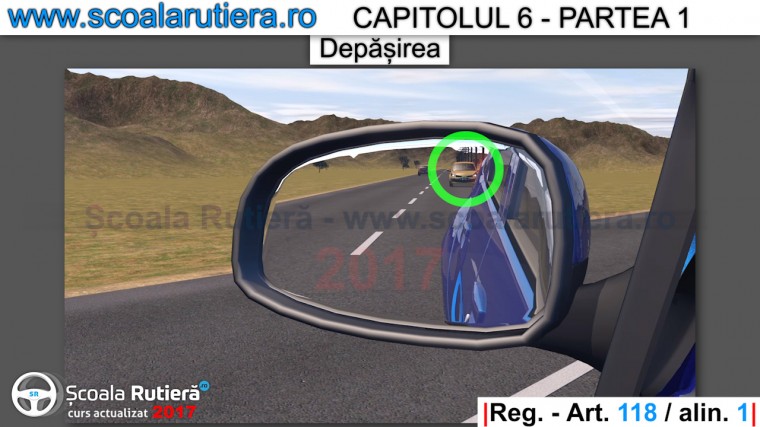


These legislative provisions regarding overtaking bicycles or electric scooters were added in 2021 in the road legislation.
To ensure a proper lateral safety distance, the drivers of motor vehicles (except motor vehicles with two wheels), will perform the overtaking maneuver of bicycles or electric scooters respecting, besides the obligations regarding the overtaking maneuver, also the following obligations, depending on the speed with which they travel (art. 118 paragraph 2 of the Regulation):


In conclusion, if you travel with up to 50 km/h you are obliged at least to violate the marking, and if you travel with more than 50 km/h you are obliged at least to cross with half of the width of the motor vehicle over the marking. It must be remembered that the above are not just recommendations, they are obligations, and failure to comply with them is sanctioned according to the law.


It must be remembered that in the case in which a road sector has this marking made with a continuous line overtaking bicycles or electric scooters can no longer be performed, because is prohibited the violating or crossing over this marking with a continuous line, and for overtaking these vehicles it is obligatory to violate or cross over this marking. The only option, according to the Regulation, is to go behind these vehicles until the end of the marking with continuous line and the beginning of the marking with a discontinuous line which can be violated and the overtaking of these vehicles can be performed according to the Regulation.


These legislative provisions regarding overtaking bicycles or electric scooters were added in 2021 in the road legislation.
- not to increase the travel speed. He must travel with a constant speed or, if necessary, he may reduce the travel speed, but in no case is he allowed to increase the speed of travel;

- to travel as close as possible to the right edge of the carriageway or of the traffic lane on which he travels. Although normally he must position himself somewhere in the center of the traffic lane, when he notices that he is going to be overtaken he is obliged to position himself as close as possible to the right edge of the road or of the traffic lane on which he travels.

- Is prohibited the overtaking of all vehicles in intersections with undirected traffic. Attention! Is prohibited the overtaking of all vehicles, even the overtaking of bicycles or electric scooters;

- near the top of a slope, when visibility is reduced below 50 m;

- in the curves in which visibility is reduced below 50 meters, as well as in any other places where visibility is reduced below 50 meters, from different conditions;

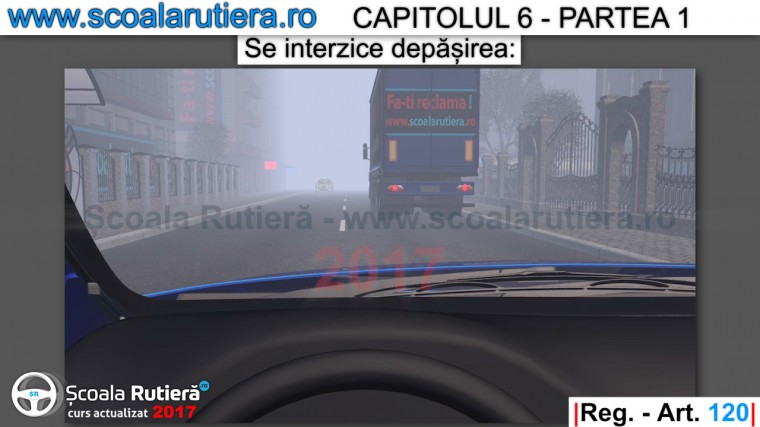
- on uneven passages, on bridges, under bridges and in tunnels. By exception, in these places only the animal-drawn vehicles, motorcycles without sidecar, mopeds, bicycles and electric scooters may be overtaken, only if the visibility over the road is greater than 20 meters, and the width of the road is greater than 7 meters;


- on pedestrian crossings signalled by signs and markings. The prohibition also applies in the case of pedestrian crossings with traffic lights, because these are signalled, besides traffic lights, also by signs and markings. Attention! Is prohibited the overtaking of all vehicles, including the overtaking of bicycles or electric scooters, whether or not the marking of separation of the directions or the marking of separation of the lanes on the same direction is crossed;
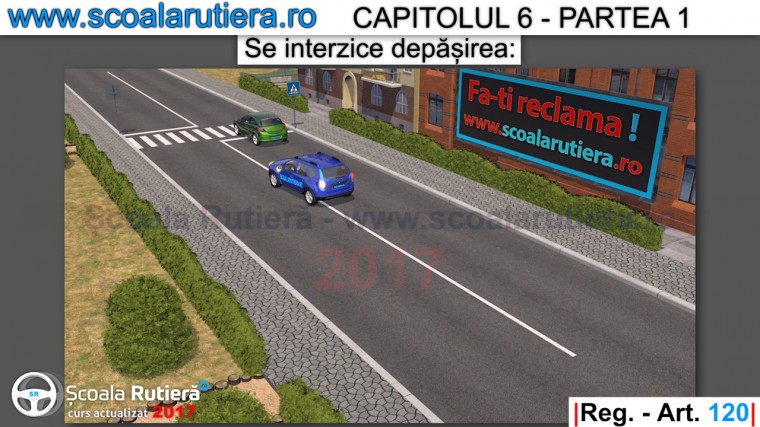
- on level crossings with the current railway and at less than 50 meters before them. Attention! Is prohibited the overtaking at less than 50 meters before them, not after them;

- at the tram station, when it is stopped, and the station is not provided with a refuge for pedestrians. The prohibition applies both on the road with two-way traffic and on the road with one-way traffic;

- in the action area of the sign "No overtaking". More exactly in the action area of the signs:

- when for performing the maneuver the continuous marking, simple or double, which separates the directions of travel, is violated, and the motor vehicle moves, even partially, on the opposite direction, or the marking which delimits the space prohibited to vehicle traffic is violated;
space prohibited to vehicle traffic = the marking applied outside the lanes, formed of parallel lines, surrounded or not with a contour line, delimits the space prohibited to traffic.

- when from the opposite direction another vehicle is approaching, and its driver is obliged to perform maneuvers to avoid the collision;

- on the road section where a queue of vehicles in waiting has formed, if by this the opposite direction of travel is entered, such as the queues of vehicles waiting at the red light of the traffic light or at level crossings with the railway, but not only these;
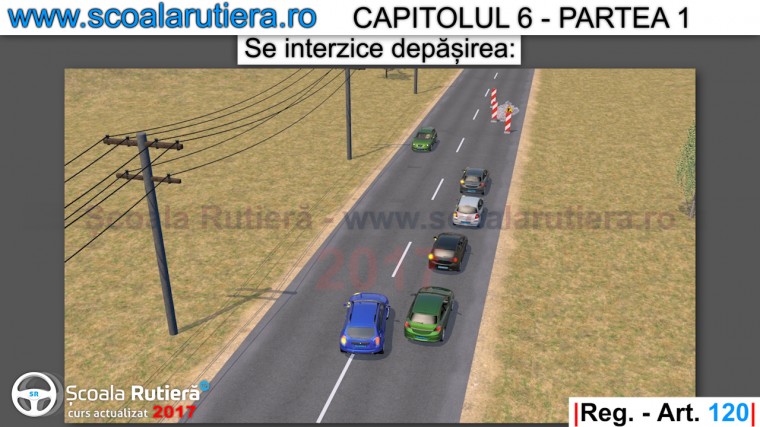

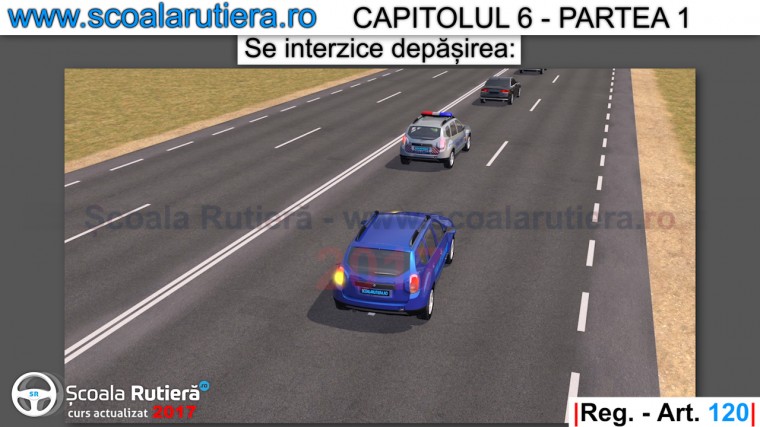
- is prohibited the overtaking of the official convoy or the intercalation or attachment to such an official convoy.














Leave a comment