



* OUG = Government Emergency Ordinance no. 195 of December 12, 2002, updated (Road Traffic Code)
** Regulation = Regulation for the implementation of the Government Emergency Ordinance (OUG) 195/2002 updated (Road Traffic Code Regulation)
(1) Deregistration from the records of vehicles is carried out by the authority which performed the registration or recording, at the request of the owner, only in the following cases:
a) the owner wishes the withdrawal from traffic of the vehicle and provides proof of its storage in an appropriate space, held under the conditions of the law;
b) the owner provides proof of dismantling, scrapping or handing over of the vehicle to specialised units for dismantling, in which case the deregistration is final;
c) upon taking a vehicle out of Romania, for the purpose of registration in another state;
d) in case of theft of the vehicle.
(2) Deregistration from the records of recorded vehicles, upon their transfer into the ownership of another person, is carried out by the authority which performed the recording, at the request of the owner, under the conditions of the law.
(3) It is prohibited to drive on public roads vehicles deregistered from the records.
(4) Vehicles declared, according to the law, by disposition of the local public administration authority, as without owner or abandoned are deregistered ex officio within 30 days from the receipt of that disposition.
(5) Deregistration from the records of a vehicle is carried out, ex officio, by the authority which performed the registration, also in the following situations:
a) in case of the notification received from competent authorities or authorised economic operators to issue the certificate of destruction, which attests that the vehicle was definitively taken out of use;
b) in case of the notification received from competent authorities, which attests that the vehicle was permanently registered in another state.
c) upon the notification of the Ministry of Foreign Affairs, in case of motor vehicles and trailers belonging to diplomatic missions, consular offices and their members, as well as to other foreign organisations and persons with diplomatic or consular status;
d) based on a court decision that remained final.
e) in case the suspension of the registration of the vehicle provided in Article 11 paragraph (4^3) operated for an uninterrupted period of 9 months;
f) in the other cases provided by the law in which the suspension of the registration of the vehicle operated for an uninterrupted period of 3 years, except for vehicles of historical interest for which there is the corresponding mention in the “Observations” section of the registration certificate, in which case the period of operation of the suspension of the registration is 10 years.
(5) Confiscation is ordered by the traffic police through the minutes of finding of the contravention, at the same time as applying the sanction of the fine.
(6) Subject to confiscation are:
a)special warning light and sound devices owned, mounted and used on motor vehicles other than those provided in Article 32 paragraphs (2) and (3);
OUG - Article 32
(2) Are authorised to use special warning light signals:
a) for the red light - the motor vehicles belonging to the police and to the firefighters;
b) for the blue light - the motor vehicles belonging to the police, the gendarmerie, the border police, the Romanian Customs Authority, the National Agency for Fiscal Administration, the ambulance service or forensic medicine, civil protection, the public Salvamont and Salvaspeo services organised by county councils and local councils, the Ministry of National Defence which escort military columns, the special units of the Romanian Intelligence Service and of the Protection and Guard Service, the National Administration of Penitentiaries within the Ministry of Justice, as well as the service motor vehicles of prosecutors within the Public Ministry, when they drive in intervention actions or in missions which have an emergency character;
c) for the yellow light - the motor vehicles with masses and/or overall dimensions exceeded or which escort such vehicles, those which transport certain goods or dangerous substances, those intended for the maintenance, repair or checking of works carried out on the carriageway or for the execution of road works, street cleaning, snow removal or towing, the transport and roadside assistance of motor vehicles that remained broken down or damaged, as well as the tractors that tow agricultural and technological implements with overall dimensions exceeded.(3) The motor vehicles provided in paragraph (2) letters a) and b) must also be equipped with special sound warning devices.
b) devices which interfere with the operation of technical means for traffic surveillance;
c) registration or record number plates which do not comply with the standards in force and which are mounted on vehicles;
d)vehicles with animal traction, when they drive on public roads to which access is prohibited or on routes other than those established by the local public authorities*).
(7) The immobilisation of a vehicle consists in removing it from the carriageway, onto the shoulder or as close as possible to the edge of the road, and rendering it incapable of movement by using technical devices or other blocking means.
(1) The immobilisation of a vehicle is ordered by the traffic police officer in case of the commission by its driver of one of the following acts:
a) driving a vehicle that is not registered or recorded, or with a false registration or record number, or without having the registration or record number plates mounted;
b) driving a vehicle which damages the public road or affects the environment or which shows dangerous deficiencies in the braking system or in the steering mechanism;
c) driving a vehicle in breach of the rules regarding the transport of dangerous goods or with exceeded overall dimensions and/or masses;
d) driving a vehicle about which there are data or indications that it is the object of an act of a criminal nature;
e) refusal to identify himself;
f) is under the influence of alcoholic beverages or psychoactive substances, and the driving of the vehicle cannot be ensured by another person;
g) does not comply with the driving and rest times provided by the law.
(2) The immobilisation of a vehicle is also ordered in case the driver thereof or one of the passengers commits an act of a criminal nature or is pursued for the commission of an offence.
(1) Special light and sound warning devices, as well as devices which interfere with the operation of technical means for traffic surveillance, confiscated under the conditions of the law, are handed over to the traffic police service within whose territorial area the act was found.
(2)Registration or record number plates confiscated under the conditions of the law are handed over to the traffic police service within whose territorial area the act was found, in order to be sent to the competent authority which issued them.
(3) Vehicles with animal traction confiscated under the conditions of the law are handed over to the local public administration authorities, based on minutes, in order to be transmitted for valorisation, according to the provisions of Government Ordinance no. 128/1998 regulating the manner and conditions of valorisation of goods confiscated or entered, according to the law, into the private property of the state, approved with amendments and completions by Law no. 98/1999, republished.
Revocation of the immobilisation is ordered:
a) by the traffic police officer who ordered it, if he is present and the reasons for which it was ordered have ceased;
b) by the head of the traffic police service to which the finding officer belongs, if the reasons for which the measure was ordered have ceased;
c) by the prosecutor or by the court of law, when the vehicle was the object of an offence.
If you cannot/do not wish to watch the AUDIO-VIDEO version of the course, you can read the text version illustrated with images.
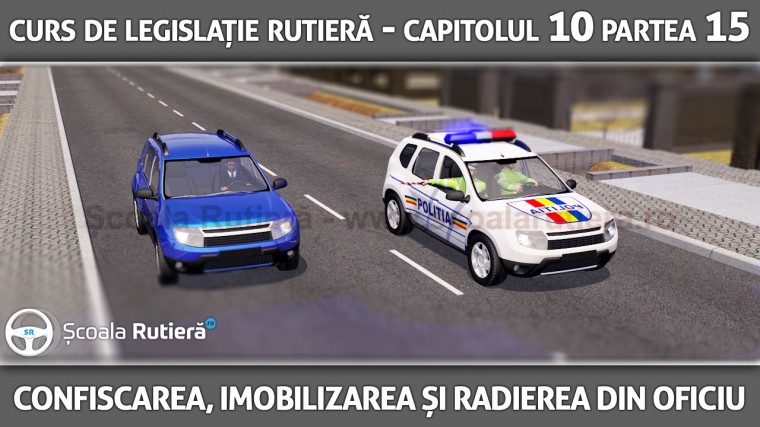
Confiscation is ordered by the traffic police through the minutes of finding of the contravention, at the same time as applying the sanction of the fine (Article 96 paragraph (5) of the OUG).
Subject to confiscation are (Article 96 paragraph (6) of the OUG):
Special light and sound warning devices, as well as devices which interfere with the operation of technical means for traffic surveillance, confiscated under the conditions of the law, are handed over to the traffic police service within whose territorial area the act was found (Article 215 paragraph (1) of the Regulation).
Registration or record number plates confiscated under the conditions of the law are handed over to the traffic police service within whose territorial area the act was found, in order to be sent to the competent authority which issued them (Article 215 paragraph (2) of the Regulation).
Vehicles with animal traction confiscated under the conditions of the law are handed over to the local public administration authorities, based on minutes, in order to be transmitted for valorisation (Article 215 paragraph (3) of the Regulation).
The immobilisation of a vehicle consists in removing it from the carriageway, onto the shoulder or as close as possible to the edge of the road, and rendering it incapable of movement by using technical devices or other blocking means (Article 96 paragraph (7) of the OUG).
The immobilisation of a vehicle is ordered by the traffic police officer in case of the commission by its driver of one of the following acts (Article 117 paragraph (1) of the OUG):
The immobilisation of a vehicle is also ordered in case the driver thereof or one of the passengers commits an act of a criminal nature or is pursued for the commission of an offence (Article 117 paragraph (2) of the OUG).
Revocation of the immobilisation is ordered (Article 218 of the Regulation):
Deregistration from the records of vehicles is carried out by the authority which performed the registration or recording, at the request of the owner, only in the following cases (Article 17 paragraph (1) of the OUG):
Deregistration from the records of recorded vehicles, upon their transfer into the ownership of another person, is carried out by the authority which performed the recording, at the request of the owner, under the conditions of the law (Article 17 paragraph (2) of the OUG).
It is prohibited to drive on public roads vehicles deregistered from the records (Article 17 paragraph (3) of the OUG).
Vehicles declared, according to the law, by disposition of the local public administration authority, as without owner or abandoned are deregistered ex officio within 30 days from the receipt of that disposition (Article 17 paragraph (4) of the OUG).
Deregistration from the records of a vehicle is carried out, ex officio, by the authority which performed the registration, also in the following situations (Article 17 paragraph (5) of the OUG):
Leave a comment