OUG = EMERGENCY ORDINANCE no. 195 of December 12, 2002 (Road Traffic Code)
Regulation = REGULATION for the implementation of OUG 195/2002 (Road Traffic Code Regulation)
(1) The driver of a vehicle who performs a manoeuvre of changing the direction of travel, of leaving a row of waiting vehicles or entering such a row, of moving to another traffic lane or of turning right or left or who is going to perform a U-turn or to move in reverse is obliged to signal in time and to make sure that he can do it without disturbing the traffic or endangering the safety of the other road users.
(2) The signalling of the change of direction of travel must be maintained for the entire duration of the manoeuvre.
(1) Stopping is considered the voluntary immobilisation of a vehicle on the public road, for a duration of up to 5 minutes. Over this duration, the immobilisation is considered waiting.
(2) Not considered stopping:
a) the immobilisation of the vehicle as long as necessary for the boarding or alighting of some persons, if through this manoeuvre the traffic on the respective public road has not been disturbed;
b) the immobilisation of the motor vehicle having a maximum authorised total mass of up to 3.5 tonnes, as long as necessary for the operation of distributing food goods to commercial units.
(4) Parking is considered the waiting of vehicles in specially designated or established and properly signalled spaces.
(1) The traffic police can order the removal of irregularly waiting vehicles. The removal and storage of vehicles in specially designated places is carried out by the local public administrations or by the administrator of the public road, as appropriate. (Paragraph (1) was modified and updated on www.scoalarutiera.ro on 20-11-2022)
(2) The cost of the removal, transport and storage of the irregularly waiting vehicle is borne by its owner.
(3) The removal of vehicles ordered by the traffic police under the conditions provided in paragraph (1) is carried out according to the procedure established by the regulation.
(7) It is prohibited to occupy pavements with immobilised vehicles, and when this is allowed, according to signs or markings, the minimum width of the pavement left at the disposal of pedestrians must be at least one metre.
(1) The drivers of vehicles are obliged to signal the change of direction of travel, overtaking, stopping and setting the vehicle in motion.
(2) The intention of the drivers of motor vehicles, agricultural or forestry tractors and trams to change the direction of travel, to leave a row of waiting vehicles or to enter such a row, to move to another traffic lane or to turn right or left or of those who are going to perform a U-turn, overtaking or stopping is signalled by activating the direction indicator lights at least 50 m in urban areas and 100 m outside urban areas before beginning the manoeuvres. (Paragraph (2) was modified and updated on www.scoalarutiera.ro on 06-10-2021)
(6) Waiting on the carriageway, at night, of agricultural or forestry tractors, trailers, mopeds, bicycles, electric scooters, animal-drawn vehicles or those pulled or pushed by hand is not allowed. (Paragraph (6) was modified and updated on www.scoalarutiera.ro on 06-10-2021)
(7) Stopping or waiting in tunnels is not allowed. In emergency or danger situations, the driver of the motor vehicle is allowed to stop or wait only in specially designated and properly signalled places. In case of prolonged immobilisation of the motor vehicle in the tunnel, the driver of the vehicle is obliged to stop the engine.
Is prohibited the voluntary waiting of vehicles:
a) in all cases in which voluntary stopping is prohibited;
b) in the action area of the sign with the meaning "No waiting" and of the marking with the meaning of waiting prohibition;
c) on public roads with a width of less than 6 m;
d) at the access ways serving properties adjacent to public roads;
e) on descents and on climbs;
f) in the place where the sign with the meaning "Alternate waiting" is installed, on another day or period than the allowed one, or the sign with the meaning "Waiting area with limited duration" beyond the set duration.
(2) The administrator of the public road may arrange, on certain areas of the pavement, with the approval of the traffic police, spaces intended for stopping or waiting of vehicles, marked and signalled accordingly. The arrangements can be executed only if:
a) the corridor intended for pedestrian traffic, established according to the regulations in force, which cannot be less than 1 m in width, is respected;
b) the access of vehicles to the parking is carried out from the carriageway;
c) the positioning of vehicles in the parking does not hinder traffic on the first lane or on the arranged tracks.
(3) Parking spaces for motor vehicles cannot be arranged on the pavement less than 10 m from intersections, public transport stations or pedestrian crossings.
(1) The removal of the vehicle represents the technical-administrative measure which the traffic police officer may order in one of the situations provided in art. 143, when the vehicle is waiting irregularly on the carriageway.
(2) The removal of vehicles constitutes a public service and is carried out, according to Emergency Ordinance of the Government no. 195/2002, republished, with subsequent amendments and completions, for 24 hours, by the administrator of the public road or, as the case may be, by the local public administration.
(4) The removal of the vehicle belonging to an institution among those provided in art. 32 paragraph (2) letters a) and b) of the Emergency Ordinance of the Government no. 195/2002, republished, with subsequent amendments and completions, carrying out an intervention action or mission with emergency character, is not ordered.
(5) The driver of the vehicle is directly responsible in the situation in which the presence of some persons in the vehicle is not visible during the ordering or enforcement of the technical-administrative measure.
(1) The removed vehicle is returned after proving the payment of the fee related to the operation/operations carried out, based on the documents attesting the ownership or legal possession of it.
If you cannot/do not want to watch the AUDIO-VIDEO version of the course, you can read the text version illustrated with images.

a) in all cases in which voluntary stopping is prohibited (that is, the 16 cases in which voluntary stopping is prohibited, which we have listed at the prohibition of stopping, which you can find here --> Chapter 6 - part 3 - manoeuvres - prohibited stopping);
b) in the action area of the sign with the meaning "No waiting" and of the marking with the meaning of waiting prohibition (the marking can also be yellow) (( If the "No waiting" sign is installed alone, waiting is prohibited from its location and up to the corner of the first intersection, regardless of the length of the sector. It can also be accompanied by additional panels, the additional panel "Arrow with the tip up" indicates the beginning of the action area, the additional panel "Arrow with two tips, one up and one down" means confirmation of the action area, and the additional panel "Arrow with the tip down" means the end of the action area of the sign. The sign can also be accompanied by the additional panel "Arrow with the tip up" which indicates the beginning of the action area and the distance of action of the sign, expressed in metres.));


c) on public roads with a width of less than 6 m;

d) at the access ways serving properties adjacent to public roads;

e) on descents and on climbs;
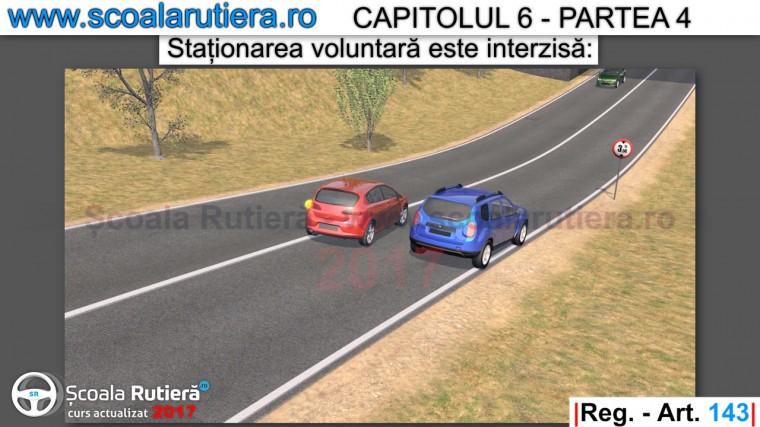
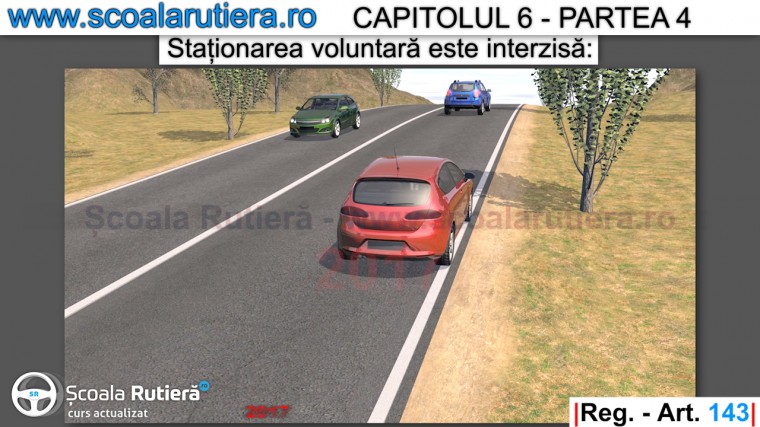
f) in the place where the sign with the meaning "Alternate waiting" is installed, on another day or period than the allowed one, or the sign with the meaning "Waiting area with limited duration" beyond the set duration


Stopping or waiting in tunnels is not allowed. In emergency or danger situations, the driver of the motor vehicle is allowed to stop or wait only in specially designated and properly signalled places. In case of prolonged immobilisation of the motor vehicle in the tunnel, the driver of the vehicle is obliged to stop the engine (art. 141 paragraph 7 of the Regulation).
Waiting on the carriageway, at night, of agricultural or forestry tractors, trailers, mopeds, bicycles, electric scooters, animal-drawn vehicles or those pulled or pushed by hand is not allowed (art. 141 paragraph 6 of the Regulation).
A particular case of waiting is parking. Parking is considered the waiting of vehicles in specially designated or established and properly signalled spaces (art. 63 paragraph 4 of OUG).

Parking spaces will be signalled with the following signs:

The position of the vehicle in the parking place is:
- if there is no parking marking, vehicles will be parked next to and parallel with the right edge of the road, in a single row, one after the other. On the parking sign it can be specified through a drawing how the parking will be performed, for example with all wheels on the pavement.

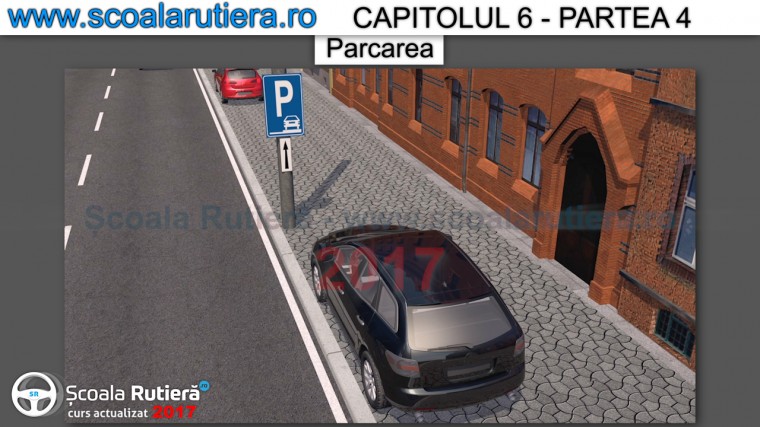
- if there is parking marking, the position of the parked vehicles will be the one indicated by the markings.
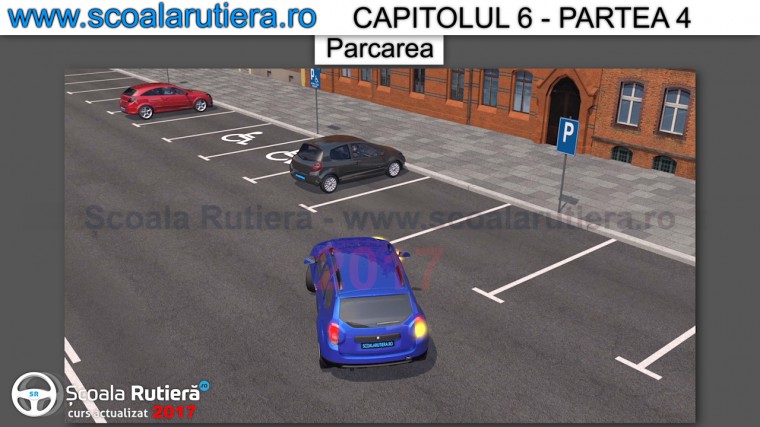
Types of parking spaces on the public road:
- parking parallel with the axis of the road;

- parking perpendicular to the axis of the road;

- oblique parking to the axis of the road.

The traffic police can order the removal of irregularly waiting vehicles. The removal and storage of vehicles in specially designated places is carried out by the local public administrations or by the administrator of the public road, as appropriate (art. 64 paragraph 1 of OUG).
The cost of the removal, transport and storage of the irregularly waiting vehicle is borne by its owner (art. 64 paragraph 2 of OUG).
The removal of the vehicle represents the technical-administrative measure which the traffic police officer may order in one of the situations when the vehicle is waiting irregularly on the carriageway (art. 203*1 paragraph 1 of the Regulation).
The removal of the vehicle is not ordered or, if it has been ordered, it is not enforced or it ceases, in the case in which the presence of some persons in the vehicle is visible (art. 203*1 paragraph 3 of the Regulation).
The removal of the vehicle belonging to an institution carrying out an intervention action or mission with emergency character is not ordered (art. 203*1 paragraph 4 of the Regulation).
The driver of the vehicle is directly responsible in the situation in which the presence of some persons in the vehicle is not visible during the ordering or enforcement of the technical-administrative measure (art. 203*1 paragraph 5 of the Regulation).
The removed vehicle is returned after proving the payment of the fee related to the operation/operations carried out, based on the documents attesting the ownership or legal possession of it. (art. 203*4 paragraph 1 of the Regulation)
It is prohibited to occupy pavements with immobilised vehicles, and when this is allowed, according to signs or markings, the minimum width of the pavement left at the disposal of pedestrians must be at least one metre (art. 72 paragraph 7 of OUG).
The administrator of the public road may arrange, on certain areas of the pavement, with the approval of the traffic police, spaces intended for stopping or waiting of vehicles, marked and signalled accordingly. The arrangements can be executed only if (art. 144 paragraph 2 of the Regulation):
- the corridor intended for pedestrian traffic, established according to the regulations in force, which cannot be less than 1 m in width, is respected;
- the access of vehicles to the parking is carried out from the carriageway;
- the positioning of vehicles in the parking does not hinder traffic on the first lane or on the arranged tracks.
Parking spaces for motor vehicles cannot be arranged on the pavement less than 10 m from intersections, public transport stations or pedestrian crossings (art. 144 paragraph 3 of the Regulation).














Leave a comment